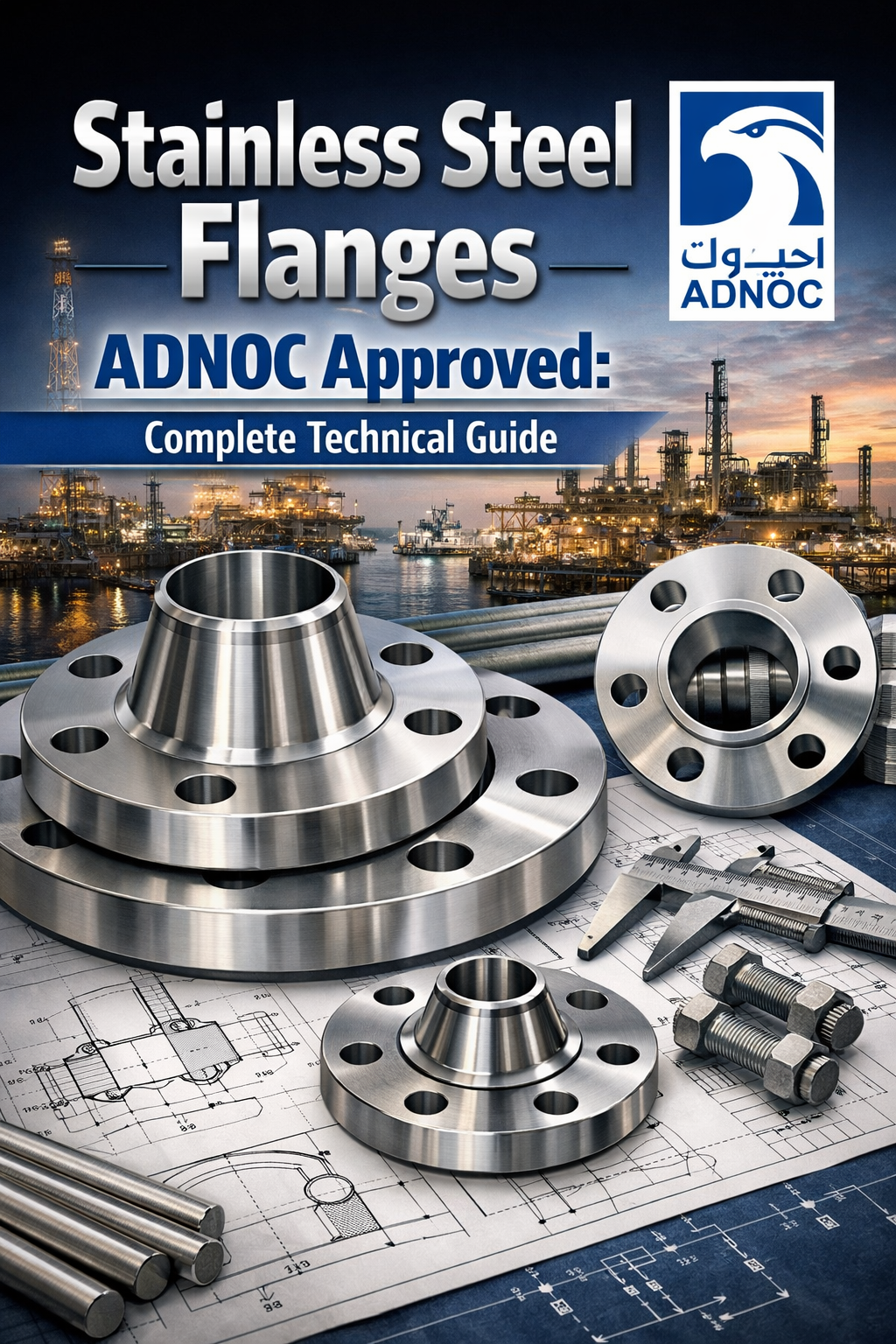
Stainless Steel Flanges ADNOC Approved are among the most critically specified components in the UAE’s oil, gas, and petrochemical sectors. From the massive offshore rigs in Abu Dhabi’s territorial waters to the intricate piping networks of onshore refineries, every flanged connection must meet Abu Dhabi National Oil Company (ADNOC) procurement and technical standards — without exception.
This complete technical guide is designed for procurement engineers, piping designers, project managers, and supply chain professionals — whether you are based in the UAE, India, Europe, or the Americas. If your project falls under ADNOC’s supply chain requirements, the information here will help you select the right product, understand the applicable specifications, and identify qualified suppliers.
What Does ADNOC Approval Mean for Stainless Steel Flanges?
ADNOC — the Abu Dhabi National Oil Company — maintains a rigorous Vendor Registration and Qualification System (VRQS) for all materials and equipment used across its operating companies, including ADNOC Offshore, ADNOC Onshore, ADNOC Refining, ADNOC Gas, and ADNOC Distribution.
When a manufacturer or supplier achieves ADNOC approval status, it confirms that their products and quality management systems have been independently audited, their materials have been tested against defined acceptance criteria, and their documentation packages comply with ADNOC’s engineering standards and international codes.
For Stainless Steel Flanges ADNOC Approved, this means every flange leaving an approved facility carries traceability — from raw material heat certification to final dimensional inspection — backed by third-party verification from agencies such as Bureau Veritas, Lloyd’s Register, TÜV, or DNV.
Technical Specifications for ADNOC Approved Flanges: Key Standards and Grades
Understanding the technical specifications for ADNOC approved flanges requires familiarity with the international codes and material standards that ADNOC references in its procurement documents. The following outlines the most commonly required parameters.
Dimensional and Pressure Standards
ADNOC-approved stainless steel flanges are primarily governed by ASME B16.5 (for sizes ½” to 24″) and ASME B16.47 (for sizes 26″ to 60″). Pressure class ratings typically specified include Class 150, 300, 600, 900, 1500, and 2500. Facing types include Raised Face (RF), Ring Type Joint (RTJ), and Flat Face (FF), with RTJ being the most common in high-pressure sour service applications.
Approved Stainless Steel Material Grades
ADNOC projects typically specify material grades in accordance with ASTM/ASME standards. The most frequently approved stainless steel grades include the following:
Common Flange Types Specified in ADNOC Projects
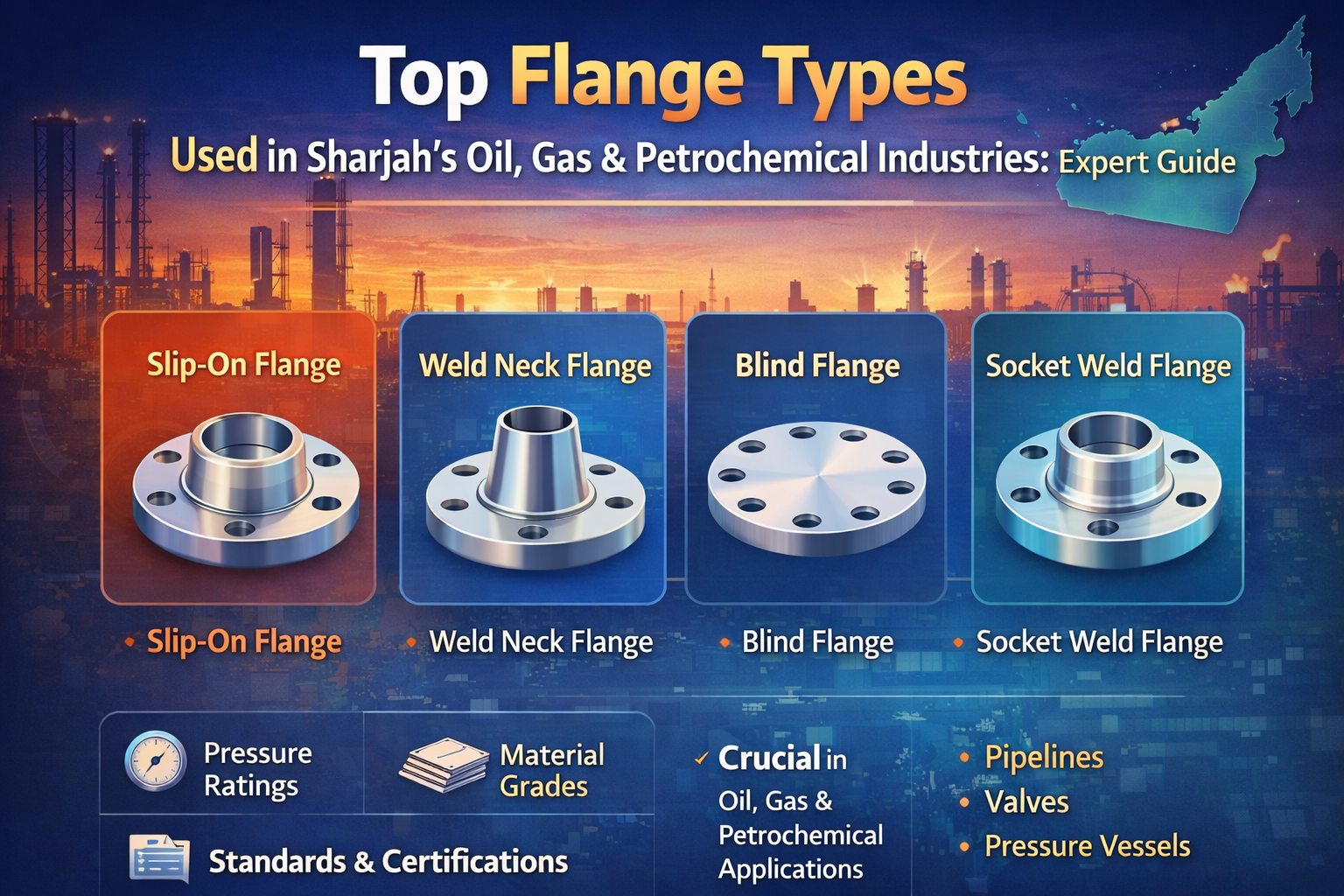
Weld Neck (WN) flanges are the most widely used in ADNOC’s critical service applications due to their superior fatigue resistance and pressure integrity. Slip-On (SO) flanges are used in lower-pressure, non-critical lines. Socket Weld (SW) and Threaded flanges are common in utility and instrument piping. Blind flanges are essential for line terminations and vessel nozzle isolation. Lap Joint flanges are used where frequent dismantling is required for inspection access.
Why Sourcing from ADNOC Approved Stainless Steel Flange Suppliers in UAE Matters
Working with ADNOC approved stainless steel flange suppliers in UAE provides several critical project advantages that extend far beyond simple product availability.
Faster Lead Times: UAE-based approved suppliers maintain bonded warehouse stock of common grades and sizes, significantly reducing lead times compared to international sourcing. For brownfield ADNOC projects with tight turnaround requirements, this is often the decisive factor.
Full Documentation Compliance: Approved suppliers are pre-qualified to deliver the complete documentation package required by ADNOC — including Mill Test Reports (MTRs), Third-Party Inspection (TPI) certificates, Positive Material Identification (PMI) test records, Hydrostatic test reports, and ADNOC Material Receiving Inspection (MRI) readiness packages.
Regulatory and Local Content Alignment: The UAE’s In-Country Value (ICV) programme, which ADNOC actively promotes, favours procurement from UAE-registered suppliers. Sourcing from ADNOC approved stainless steel flange suppliers in UAE supports your project’s ICV score and satisfies local content obligations in the supply chain.
Reduced Commercial Risk: Working with pre-approved vendors eliminates the risk of material rejection at the ADNOC site gate — a costly outcome that delays projects and triggers non-conformance reports (NCRs) requiring formal resolution.
What to Look for in a Stainless Steel Flanges Manufacturer for Oil and Gas UAE
Selecting the right stainless steel flanges manufacturer for oil and gas UAE requires evaluation across multiple technical and commercial dimensions. The following criteria define a genuinely qualified manufacturer for ADNOC-scope projects.
Active ADNOC Vendor Registration: Verify that the manufacturer holds a current, active ADNOC VRQS registration in the relevant product category. ADNOC’s approved vendor list is periodically reviewed and updated — always confirm status before contract award.
ISO 9001 and PED Certification: ISO 9001:2015 quality management system certification is a baseline requirement. For international supply, compliance with the European Pressure Equipment Directive (PED 2014/68/EU) adds further credibility, as does adherence to NACE MR0175 / ISO 15156 for sour service material qualifications.
In-House Testing Capabilities: A qualified stainless steel flanges manufacturer for oil and gas UAE should operate in-house hardness testing, PMI (XRF analysis), dimensional inspection per ASME B16.5, hydrostatic pressure testing, and impact testing (Charpy) for low-temperature service grades. Reliance solely on external labs can create documentation chain-of-custody issues.
Heat Traceability and Raw Material Sourcing: ADNOC requires full heat traceability — each flange must be traceable to its original steel melt. Manufacturers sourcing raw material from ADNOC-approved or internationally recognised steel mills (such as Outokumpu, Aperam, Acerinox, or Sandvik) provide the highest degree of material assurance.
Essential Documentation Package for ADNOC Flange Supply
Every shipment of Stainless Steel Flanges ADNOC Approved must be accompanied by a complete documentation dossier. Procurement teams should verify the following documents are included before accepting material at site.
The mandatory documentation set includes: Mill Test Reports (EN 10204 Type 3.1 or 3.2), Dimensional Inspection Reports per ASME B16.5/B16.47, Heat Treatment Certificates, Positive Material Identification (PMI) Reports, Hydrostatic Test Certificates (where applicable), Surface Finish and Marking Verification Reports, Third-Party Inspection (TPI) Release Notes from a ADNOC-recognised inspection authority, and a Certificate of Conformance (CoC) signed by the manufacturer’s authorised quality representative.
Incomplete or non-conforming documentation is the single most common cause of material rejection and project delay in ADNOC supply chain operations. Establishing documentation requirements clearly at the purchase order stage — and verifying them before shipment — eliminates the vast majority of site gate rejections.
A Note for International Buyers and EPC Contractors
For global EPC contractors, subcontractors, and procurement agencies working on ADNOC-awarded projects, the vendor qualification landscape in the UAE can appear complex. ADNOC’s multi-opco structure means that approval with one operating company (e.g., ADNOC Offshore) does not automatically guarantee acceptance across all opcos — though cross-recognition is possible with the right documentation and prior coordination.
International buyers are strongly advised to specify ‘ADNOC-approved manufacturer’ explicitly in their ITT (Invitation to Tender) documents and request a copy of the vendor’s ADNOC registration certificate as part of the bid package. This avoids downstream qualification issues and ensures full compliance with the project’s contractual supply chain requirements.
Conclusion: Precision, Compliance, and Performance
Stainless Steel Flanges ADNOC Approved represent the intersection of material science, regulatory compliance, and operational reliability. For any project operating within ADNOC’s supply chain ecosystem, these components are not a commodity