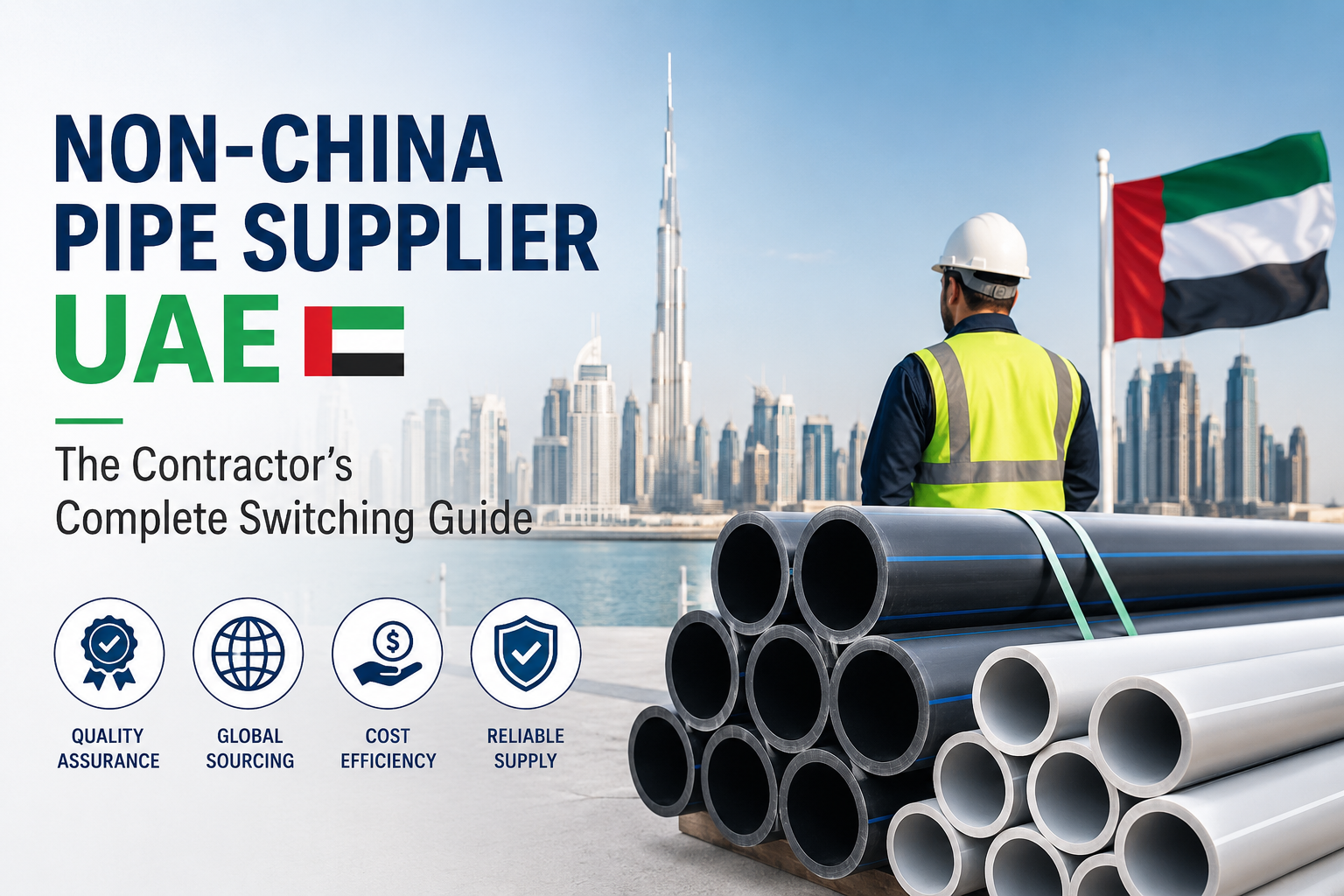
If you are running an EPC or MEP project in the UAE right now, you already know the pressure. Specifications say non-China origin. Your PMC is asking for country of origin certificates. The client’s QA team is holding a batch pending verification. And somewhere in your procurement plan, there is a gap you cannot afford.
Finding a reliable non-China pipe supplier UAE is no longer a procurement preference — it is a project survival decision. This guide walks EPC contractors, MEP firms, oil and gas companies, marine operators, power sector buyers, and procurement managers through exactly what is happening, why it matters in 2026, and how to protect every future project with the right supply chain from day one.
Why the Shift to a Non-China Pipe Supplier UAE Is Accelerating in 2026
The UAE piping market has been moving away from Chinese origin material for several years, but 2026 has brought a decisive shift. Three forces are converging at once.
End-client mandates have hardened. ADNOC group companies, major EPC houses, and international PMCs have embedded non-China origin clauses directly into material specifications. This is no longer a preference clause — it carries contractual weight and is being actively enforced at goods receipt.
Third-party inspection is more rigorous. Inspection firms operating across Abu Dhabi, Dubai, and Sharjah now conduct origin verification at a granular level. Heat numbers, mill identities, and country of melt are being checked, not just reviewed. An MTC from a Chinese mill that was re-rolled or re-certified elsewhere does not pass this scrutiny.
Anti-dumping pressure is reshaping import economics. GCC-level reviews of Chinese steel imports are changing the real cost of Chinese origin material once customs and compliance risk are factored in. The apparent price advantage is eroding precisely when specification risk is increasing.
The contractors navigating pipe supply chain disruption UAE 2026 successfully are those who moved their approved vendor lists before the problem arrived on a live project.
Chinese Steel Pipe Quality Issues UAE Projects Are Facing Right Now
Understanding why Chinese steel pipe quality issues UAE projects encounter helps you make the business case internally for switching. These are not abstract concerns — they are documented patterns that procurement teams see repeatedly.
Chemical Composition Drift
Chinese mill output, particularly from smaller and mid-tier producers, shows inconsistency in chemical composition between heats. For structural and pressure-rated applications, this matters directly. Carbon equivalent values that fall outside ASTM tolerances create weld integrity risk that only becomes visible during post-weld heat treatment or hydrotesting.
Wall Thickness Variation
Dimensional variances in wall thickness — often within nominal tolerance per individual piece but inconsistent across a lot — compound over long pipeline runs. In high-pressure oil and gas applications, this creates hot spots that accelerate fatigue failure.
MTC Traceability Gaps
This is the most operationally damaging issue. Mill test certificates that cannot be independently traced to a specific heat at a specific producing mill are, in effect, unverifiable. When a PMC or third-party inspector requests heat traceability and it cannot be provided, the material is treated as non-conforming regardless of its physical condition.
Surface Treatment and Coating Failures
Reports from UAE construction and industrial sites document coating adhesion failures, internal mill scale issues, and surface defect patterns consistent with inadequate pickling and passivation at the source mill.
Each of these issues drives pipe material rejection UAE project specification events that are far more costly than the material saving that motivated the original procurement decision.
What Pipe Material Rejection UAE Project Specification Events Actually Cost
Pipe material rejection UAE project specification enforcement is the moment when the risk becomes a real financial loss. Let us work through what a single rejection event on a mid-size EPC project actually costs.
The material itself needs replacement — typically at emergency procurement pricing, which carries a 15 to 25 percent premium over standard pricing. But that is the smallest line item.
Installation crews standing down while replacement material is sourced costs mobilization and demobilization time. On a project with daily rates of AED 80,000 to 150,000 for a full crew, a one-week delay to source and deliver replacement pipe and fittings can cost more than the entire material value of the rejected batch.
Rescheduling inspection hold points — hydrotesting, radiography, PMC sign-off — creates a downstream cascade. If one milestone slips, subsequent milestones on interdependent scopes move with it. Liquidated damages clauses tied to these milestones can make a single rejection event a six-figure loss.
Then there is the vendor prequalification impact. A rejection event is recorded. Repeat events affect your standing on approved vendor lists for future projects.
The entire financial case for sourcing from a certified pipe supplier UAE without China origin is built on this arithmetic. The premium over Chinese pricing, when it exists at all, is a fraction of the expected cost of a rejection event probability-weighted against project value.
How to Identify a Genuine Certified Pipe Supplier UAE Without China Origin
Not every supplier who claims non-China origin can actually demonstrate it. Here is the checklist that separates genuine capability from a marketing claim.
Heat-Traceable Mill Test Certificates
A verified pipe stockist UAE with mill test certificate capability means that every MTC references a specific heat number that can be cross-referenced against the producing mill’s own quality records. If a supplier cannot demonstrate this traceability on demand for current stock, origin cannot be verified.
ISO Certification of the Supplier’s Own QMS
An ISO certified pipe supplier Sharjah Dubai has an independently audited quality management system. This means documentation integrity is governed by a third-party audit cycle, not just internal practice. For projects requiring documented supply chain quality, this is a baseline requirement.
Demonstrated ADNOC and NOC Project History
Pipe supplier UAE ADNOC approved status reflects a track record of supply performance on ADNOC group projects with documented quality records. Ask for project references and cross-reference against the ADNOC approved vendor list if your project scope requires it.
Consistent Cross-Origin Inventory
A supplier with genuine alternative to Chinese pipes UAE construction capability holds inventory from European, Japanese, Korean, and other certified origins consistently — not on-order from a specific source when requested. Stock availability is the proof point. If they need lead time to source non-China origin material, they are a trader, not a stockist.
Full Fittings and Flanges Coverage
ASTM certified pipe fittings supplier Sharjah capability means the fittings, elbows, reducers, tees, and flanges carry the same origin and certification standard as the pipe. Mixed-origin piping systems where the pipe is certified but the fittings are not create specification grey zones that are exactly what rejection clauses are designed to catch.
Leema Engineering Works checks every one of these boxes. As an ISO 9001:2015 certified pipe supplier in Sharjah with over 50 years of operational history and a documented track record supplying ADNOC, KOC, KNPC, PDO, QatarGas, and other major NOCs, LEW operates as a genuine non-China origin stockist — not a pass-through trader.
European Origin Pipe Fittings Supplier UAE: Why Origin Matters Beyond the Certificate
European origin pipe fittings supplier UAE capability represents a fundamentally different manufacturing standard, and understanding why helps procurement teams defend the specification internally when cost pressure pushes back.
European steel mills operate under continuous third-party audit regimes mandated by EU industrial standards. Quality management is integrated into the production process at the melt level, not applied retrospectively. Chemical composition is controlled with precision across the full heat, and dimensional tolerances are held consistently across production runs — not just measured on sample pieces.
For non-Chinese pipe fittings GCC oil and gas applications, this matters because:
- Weld procedure qualifications are based on material properties that must be consistent between heats
- Pressure system integrity calculations assume dimensional uniformity across fittings and pipe
- Corrosion allowance calculations depend on accurate wall thickness control
Carbon steel pipe fittings non-China origin Sharjah from European and other premium-certified origins come with documentation that is genuinely verifiable against independent audit records. The heat number on the MTC connects to a specific production run at a specific mill — a record that holds up under PMC scrutiny and third-party inspection.
Leema Engineering Works supplies European origin pipe fittings alongside Japanese and Korean certified origins as standard inventory. You can review the full pipe fittings range including butt-weld, socket-weld, and threaded fittings across carbon steel, stainless steel, alloy steel, Inconel, duplex, and super duplex grades.
ASTM Certified Pipe Fittings Supplier Sharjah: Why Sharjah Is the Right Logistics Base
ASTM certified pipe fittings supplier Sharjah is not just a geographic description — it reflects a specific logistical advantage for contractors working across the UAE and wider GCC.
Sharjah’s Industrial Areas, particularly Industrial Area 2 where Leema Engineering Works operates, sit at the center of the UAE’s industrial distribution network. The proximity to Sharjah’s port infrastructure, combined with road connectivity to Dubai, Abu Dhabi, and the Northern Emirates, means that a Sharjah-based stockist can deliver to any UAE project site faster than an import-on-demand model.
For contractors managing pipe fittings flanges supplier UAE without import delays, this is operationally critical. When your installation schedule requires elbows, reducers, tees, and flanges to be on site within 48 hours of a procurement decision, a supplier with live inventory in Sharjah delivers. A supplier relying on import from overseas does not.
Leema Engineering Works maintains dedicated warehouse inventory in Sharjah Industrial Area 2 and an additional location in Abu Dhabi’s Al Danah zone, providing dual-emirate coverage for fast project supply.
Pipe Supplier UAE ADNOC Approved: What Approved Vendor Status Means in Practice
Pipe supplier UAE ADNOC approved status is an audited qualification, not a self-declared claim. ADNOC’s vendor prequalification process evaluates:
- Quality management system certification and audit history
- Material traceability capability from melt to delivery
- Financial and operational stability
- Demonstrated supply performance on relevant project types
- Compliance with ADNOC’s own material specification standards
For contractors bidding on ADNOC group projects — ADNOC Onshore, ADNOC Offshore, ADNOC Refining, Borouge, Ruwais — sourcing from an ADNOC approved pipe supplier is a procurement requirement embedded in the project specification. It is not negotiable at goods receipt.
The same framework applies across non-Chinese pipe fittings GCC oil and gas procurement for KOC, KNPC, Saudi Aramco, and PDO project environments. These clients have standardized their vendor qualification requirements, and the shift away from Chinese origin material is embedded in those standards as a clear trend.
Leema Engineering Works has an established track record supplying these end users across the GCC, which you can verify through the client portfolio.
Why Contractors Avoid Chinese Pipes UAE: The Full Risk Picture
Why contractors avoid Chinese pipes UAE is worth addressing directly, because the answer is more nuanced than a simple quality argument.
The Hidden Cost Calculation
A Chinese origin pipe lot might arrive at a 15 to 20 percent price advantage over certified European or Japanese material. On a large project with significant pipe tonnage, that looks like a meaningful saving on paper.
But probability-weight it against project risk:
- A 20 percent chance of a rejection event that costs two weeks of schedule delay at AED 100,000 per day in LADs = AED 2.8 million expected loss
- On a pipe procurement of AED 1 million, the maximum saving from Chinese pricing is AED 200,000
- The risk-adjusted math produces a negative expected value from Chinese origin sourcing on any project with meaningful LAD exposure
This is why contractors avoid Chinese pipes UAE on specification-sensitive projects. The apparent saving is not a saving at all once the probability-weighted cost of non-compliance is factored in.
Reputational Capital
Beyond direct project costs, a rejection event recorded against your company affects vendor prequalification standing with end clients. Over multiple projects, a pattern of non-compliant material sourcing can affect bidding eligibility. The cost of rebuilding that standing is difficult to quantify but real.
Pipe Supply Chain Disruption UAE 2026: How Smart Contractors Are Responding
Pipe supply chain disruption UAE 2026 is being driven by a convergence of geopolitical, regulatory, and market forces that are unlikely to reverse in the medium term.
Chinese steel export volumes are under sustained pressure from anti-dumping reviews across multiple markets. GCC customs authorities are applying more rigorous origin verification. International EPC houses operating in the UAE are enforcing their global procurement policies on Chinese origin exclusions locally. And ADNOC’s own supply chain localization and quality initiatives are pushing the non-China origin requirement deeper into project specifications.
Contractors who are ahead of this disruption are doing three things consistently:
Pre-qualifying non-China origin suppliers before project award. This means having an approved vendor relationship established, documentation reviewed, and sample MTCs on file before the project is live and the procurement clock is running.
Specifying origin in purchase orders, not just in project specs. When your own PO to a supplier carries a country of origin requirement and a documentation standard, you shift liability for origin non-compliance to the supplier where it belongs. If you only specify in the project specification and leave POs origin-neutral, the gap is yours to absorb.
Building blanket order arrangements with stockists. A blanket order with a verified pipe stockist UAE with mill test certificate supplier locks in pricing, availability commitment, and documentation standard across your project schedule. It eliminates the spot procurement premium and the last-minute supply scramble that drives rejection risk.
For a deeper look at how European and non-Chinese certified material compares technically against Asian alternatives, read the Leema Engineering Works analysis on European Carbon Steel Pipes vs Asian Carbon Steel Pipes for the UAE Market.
Quality Pipe Fittings for EPC Contractors UAE: What a Complete Supply Package Looks Like
Quality pipe fittings for EPC contractors UAE procurement is not just about the pipe itself. A complete piping system on an EPC project requires pipe, butt-weld fittings, flanges, gaskets, bolting, and valves — all carrying consistent origin, grade, and certification documentation.
When these components come from different origin sources with different documentation standards, the QA record for the system becomes fragmented. Reconciling mixed-origin documentation against a single project specification is time-consuming and creates audit gaps.
A single-source pipe fittings flanges supplier UAE without import delays who carries the full component range in consistent certified origin eliminates this complexity entirely. The QA record is clean, the traceability is continuous, and the inspection hold point is straightforward to clear.
Leema Engineering Works supplies the complete piping component range:
- Seamless and ERW carbon steel pipe in API 5L, ASTM A106, A53, A333 grades
- Butt-weld fittings to ASTM A234 WPB, WPHY grades from ½” to 96″
- Socket-weld and threaded fittings to ASTM A105N, A350 LF2
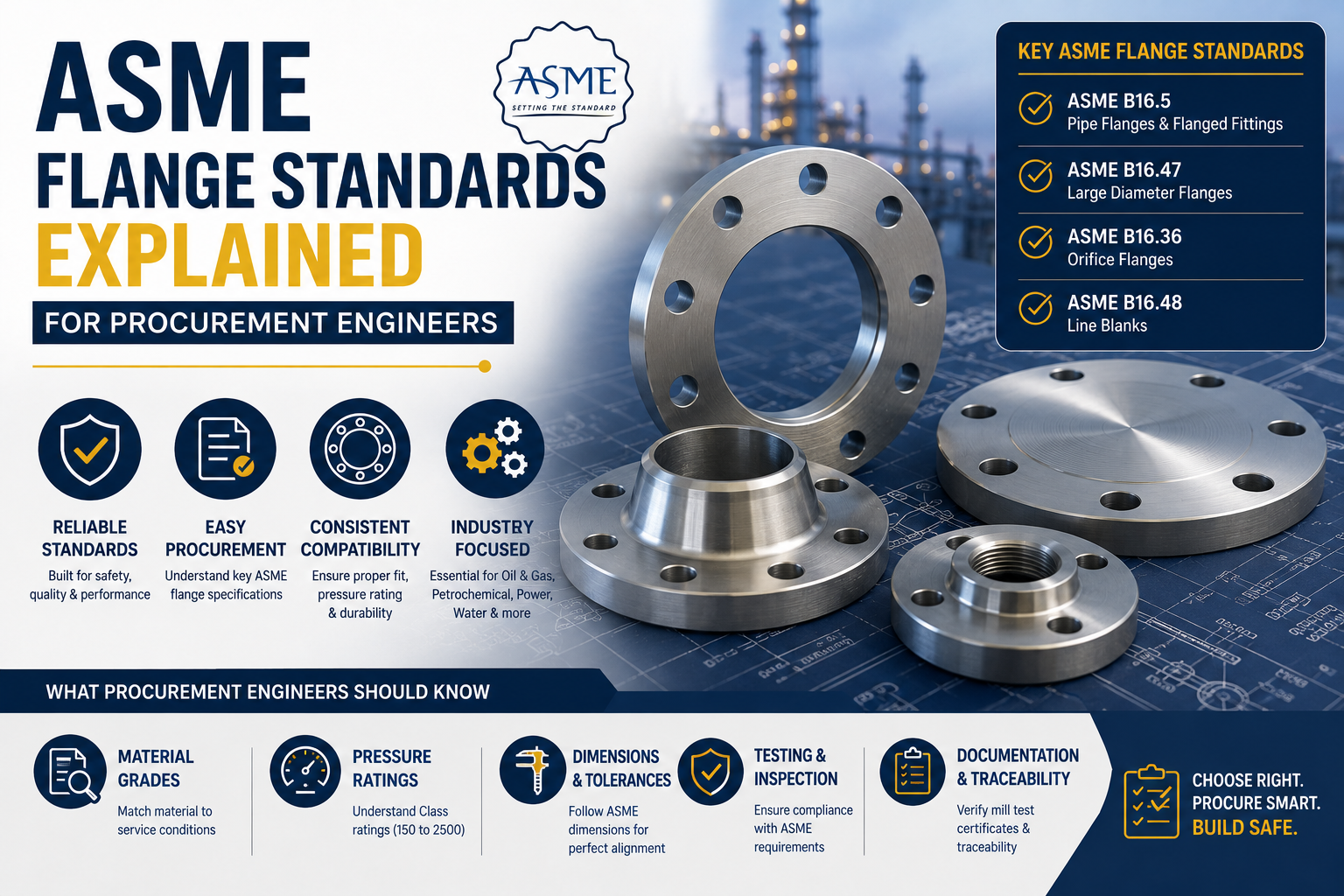
- Flanges across all facing types and pressure classes to ASME B16.5 and B16.47
- Alloy steel, stainless steel, Inconel, duplex, and super duplex in equivalent standards
Review the full flanges supply range and pipe fittings product page for detailed specification coverage.
Industries Served: From Oil and Gas to Marine and Shipbuilding
Leema Engineering Works serves the full range of industries where non-China origin pipe and fittings specifications are routinely required.
Oil and Gas. As a dedicated oil and gas piping supplier, LEW supports midstream and downstream EPC scopes with API 5L, A106, and specialty alloy pipe and fittings carrying verified origin and full MTCs. Supply history includes ADNOC, KOC, KNPC, PDO, and Petrofac project references.
Power and Utilities. The power industry supply capability covers high-pressure and high-temperature piping for power generation, district cooling, and utility infrastructure where ASME and ASTM certification is mandatory.
Construction and MEP. For construction sector projects, LEW provides carbon steel, stainless steel, GI, and specialty pipe to specification across commercial, infrastructure, and government project types.
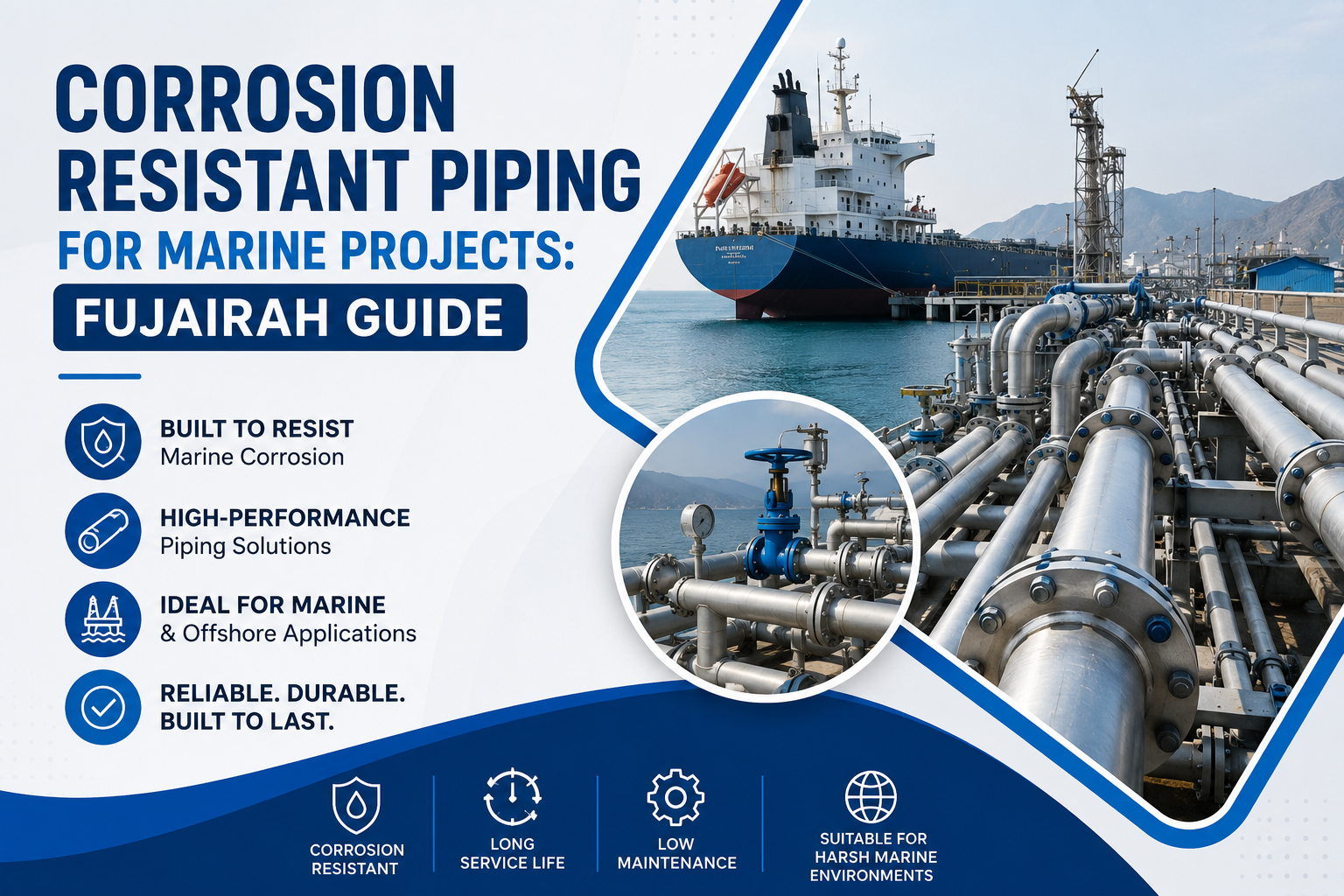
Marine and Shipbuilding. The marine and shipbuilding supply range includes corrosion-resistant grades and pressure-rated materials for shipbuilding, port infrastructure, and offshore platform applications where origin verification is standard practice.
The Complete Switching Guide: Step-by-Step for Procurement Teams
Here is the practical roadmap for making the transition to a non-China pipe supplier UAE before your next project kicks off.
Step 1 — Audit your current AVL for genuine origin capability. Ask every supplier on your approved vendor list to show you a sample MTC from current stock for a standard carbon steel pipe item. Check whether the heat number is traceable to the producing mill. If they cannot produce it within hours, origin traceability is not part of their standard process.
Step 2 — Define origin as a specified procurement requirement in your own POs. Do not rely on the project specification alone. Embed country of origin, documentary requirements, and MTC standards directly in your purchase order terms. This shifts origin liability to the supplier and creates a contractual basis for rejection cost recovery if non-compliant material is delivered.
Step 3 — Pre-qualify a certified stockist, not a trader. The difference matters. A stockist holds pipe fittings flanges supplier UAE without import delays capability because the inventory is on the shelf. A trader sources on demand. Pre-qualification of a genuine stockist like Leema Engineering Works means your supply chain can respond to project schedule changes without emergency procurement premiums.
Step 4 — Request full documentation packages upfront. For each procurement line, request: country of origin certificate, heat-traceable MTC, ASTM or API test reports, and the supplier’s ISO certificate. Review these before PO placement, not at goods receipt.
Step 5 — Establish a blanket order for the project duration. Lock in pricing, origin standard, documentation requirements, and delivery lead times across the full project schedule. This eliminates spot procurement exposure and gives your QA team a consistent documentation baseline to work against.
FAQs: Non-China Pipe Supplier UAE — What Contractors Ask Most
Q: What documentation proves a pipe is genuinely non-China origin?
The minimum documentation is a heat-traceable mill test certificate referencing a specific heat number from the producing mill, accompanied by a country of origin certificate and, on ADNOC projects, a third-party inspection certificate from an approved body such as Bureau Veritas, SGS, or Intertek. The heat number must be cross-referenceable against the mill’s own quality records. Leema Engineering Works provides all three documents as standard supply practice.
Q: Can I switch to a non-China pipe supplier mid-project without disrupting supply?
Yes, if the new supplier carries live inventory in the UAE. A Sharjah-based stockist with the full pipe, fittings, and flanges range in certified non-China origin stock can support an immediate switch without lead time delays. The critical step is pre-qualifying the supplier and reviewing their current stock documentation before issuing the first PO.
Q: Is non-China origin pipe significantly more expensive?
In the current market, the cost differential is smaller than many procurement teams expect — typically 8 to 15 percent on standard carbon steel grades. Against the risk-adjusted cost of a rejection event, that differential is not a valid basis for specifying Chinese origin material on projects with specification enforcement and LAD exposure. On projects without these factors, the appropriate procurement decision depends on the specific client requirements.
Q: What ASTM grades does a certified non-China pipe supplier UAE stock?
A well-stocked non-China origin supplier should carry at minimum: ASTM A106 Grade B seamless pipe, API 5L Grade B and X grades, ASTM A234 WPB and WPHY fittings, ASTM A105N and A350 LF2 flanges and fittings, and ASTM A312 stainless steel pipe. Leema Engineering Works stocks all of these grades plus alloy and specialty grades in sizes from ½” to 96″ and beyond.
Q: How do I verify that a supplier is genuinely ADNOC approved?
Request the supplier’s ADNOC vendor registration number and cross-reference it against ADNOC’s procurement portal or through your PMC’s vendor verification process. Do not rely on a supplier’s self-declaration. Leema Engineering Works has documented supply history across ADNOC group companies and can provide project references that can be verified through your procurement team.
Why Leema Engineering Works Is the Non-China Pipe Supplier UAE Contractors Rely On
Leema Engineering Works (LEW), headquartered in Sharjah Industrial Area 2 with an additional location in Abu Dhabi, is an ISO 9001:2015 certified non-China origin pipe, fittings, and flanges stockist with over 50 years of operating history in the UAE and GCC piping market.
LEW is a pipe supplier UAE ADNOC approved with documented supply history across ADNOC, KOC, KNPC, PDO, QatarGas, RasGas, TOTAL, ENI-Saipem, Bechtel, Technip, Petrofac, ENOC, DUBAL, and EGA.
As an ISO certified pipe supplier Sharjah Dubai, LEW’s quality management system governs documentation integrity, stock traceability, and MTC verification as part of standard operating procedure — not as a special request.
As a verified pipe stockist UAE with mill test certificate capability, LEW holds live inventory across European, Japanese, and Korean certified origins in carbon steel, stainless steel, alloy steel, Inconel, duplex, and super duplex grades.
As an ASTM certified pipe fittings supplier Sharjah, LEW covers the complete component schedule — pipe, butt-weld fittings, socket-weld fittings, threaded fittings, and flanges — in consistent certified origin with full documentation packages.
And as a pipe fittings flanges supplier UAE without import delays, LEW delivers from in-stock Sharjah inventory to any UAE location within 24 to 48 hours on standard items.
Ready to switch? Contact Leema Engineering Works with your BOQ or item list and receive a quotation with full origin documentation within hours — not days.