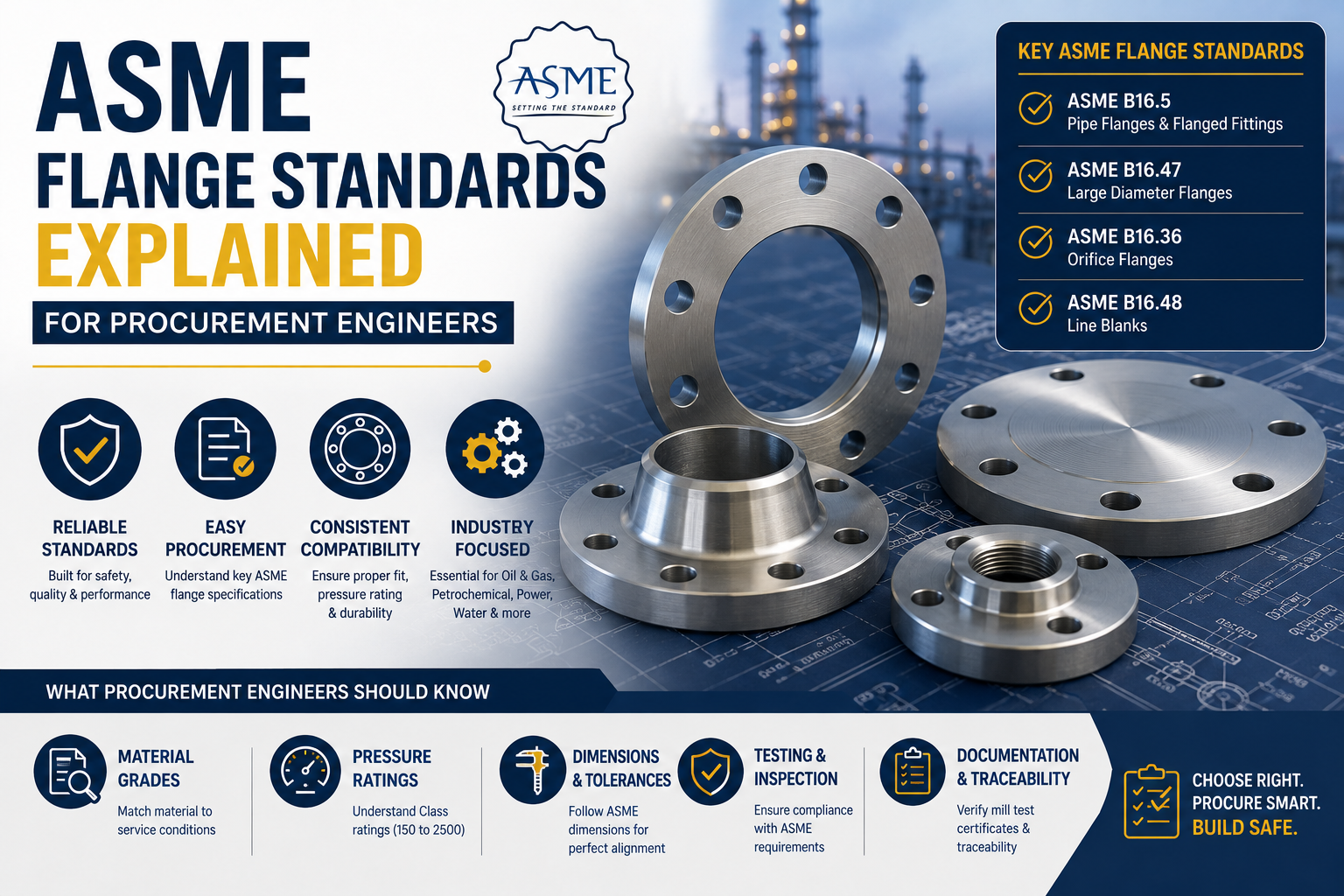
Order the wrong flange standard, and you’ll find out the hard way at the bolt-up stage — mismatched bolt patterns, incompatible pressure ratings, and a delayed project. Getting ASME Flange Standards Explained clearly, before the purchase order goes out, is exactly what prevents this expensive scenario.
Procurement teams often inherit flange specifications from engineering drawings without fully understanding what each standard reference actually governs, making it easy to miss a critical detail that only surfaces during receiving inspection or installation.
This guide breaks down every major ASME flange standard relevant to UAE industrial procurement, in language built specifically for buyers, not just design engineers.
Why ASME Flange Standards Explained Matters for Procurement, Not Just Design
Engineering drawings typically reference a standard like “ASME B16.5” almost in passing, assuming procurement teams already understand its full implications for sourcing and inspection.
Getting flange standards for procurement teams right means understanding not just that a standard exists, but exactly what it dictates about dimensions, materials, and documentation you should expect from your supplier.
As a certified flanges supplier in Sharjah, we work directly with procurement teams daily to bridge this gap between engineering specification and practical sourcing decisions.
ASME B16.5 Explained: The Foundation Standard
Understanding ASME B16.5 explained in procurement-friendly terms starts with recognizing this as the single most commonly referenced flange standard in industrial piping.
What ASME B16.5 Actually Covers
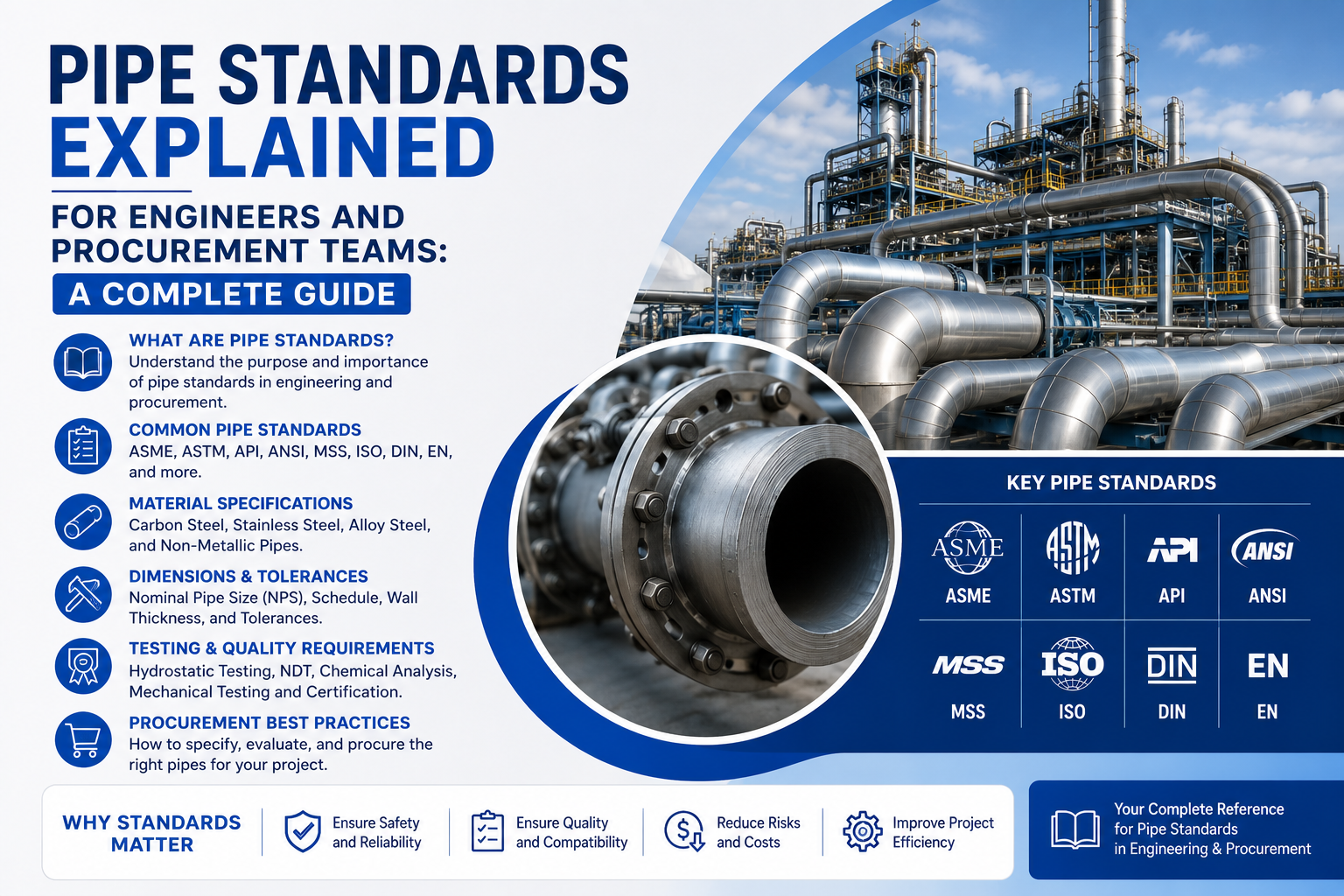
- Pipe flanges and flanged fittings from NPS ½ through NPS 24
- Pressure-temperature ratings across seven standard pressure classes
- Dimensional requirements including bolt-hole patterns, outside diameter, and thickness
- Facing types (raised face, flat face, ring-type joint) and their dimensional standards
If a specification simply says “ASME B16.5 flange,” procurement teams should always confirm the specific size, pressure class, material grade, and facing type separately — B16.5 defines the framework, not the complete order specification on its own.
ASME B16.47 Flange Standard: When B16.5 Isn’t Enough
For larger diameter applications, understanding the ASME B16.47 flange standard helps procurement teams recognize when B16.5 simply doesn’t apply.
Key Differences From B16.5
- Covers larger diameter flanges, specifically NPS 26 through NPS 60
- Split into two series — Series A and Series B — with different dimensional standards
- Series A generally aligns with older MSS SP-44 dimensions; Series B aligns more closely with international/ISO dimensional practices
- Critical to confirm which series your project specification requires, since Series A and B flanges are NOT interchangeable
Ordering the wrong series for a large-diameter flange is a genuinely common and costly procurement error — always confirm Series A vs. Series B explicitly with your engineering team before purchasing.
ASME vs ANSI Flange Standards: Clarifying a Common Confusion
Many procurement professionals use these terms interchangeably, so understanding ASME vs ANSI flange standards terminology directly helps prevent unnecessary confusion during sourcing.
The Actual Relationship
- ANSI (American National Standards Institute) is an accreditation body, not a standards-writing organization itself
- ASME develops the actual technical flange standards (B16.5, B16.47, etc.)
- These standards are often submitted to and accredited by ANSI, leading to the common “ANSI/ASME B16.5” labeling
- In practice, “ANSI flange” and “ASME flange” typically refer to the same technical specification
When a supplier or drawing references “ANSI flanges,” it’s almost always referring to ASME-developed standards that carry ANSI accreditation — functionally the same specification you’d source either way.
Flange Pressure Class Explained: Understanding the Rating System
One of the most frequently misunderstood concepts, flange pressure class explained in practical terms helps procurement teams avoid a costly specification mistake.
Understanding Pressure Classes
- Standard classes include 150#, 300#, 600#, 900#, 1500#, and 2500#
- These numbers do NOT represent a fixed pressure rating in PSI — they’re a class designation
- Actual allowable pressure varies by material grade AND decreases as operating temperature increases
- The same “300#” class flange has different actual pressure ratings depending on whether it’s carbon steel, stainless steel, or an alloy grade
Never assume a pressure class number directly equals a PSI rating — always cross-reference the specific material’s pressure-temperature table before finalizing any order involving elevated temperature service.
ASME Flange Dimensions Guide: What Physically Determines Fit
Understanding the ASME flange dimensions guide framework ensures physical compatibility across your entire piping system, particularly critical when sourcing from multiple suppliers.
Key Dimensional Elements
- Outside diameter (OD) — the overall flange size
- Bolt circle diameter (BCD) — determines where bolt holes are positioned
- Number and size of bolt holes — must match exactly between mating flanges
- Flange thickness — varies by pressure class and size
All these dimensions are precisely defined within ASME B16.5 or B16.47 depending on size range. Our pipe supplier services in Sharjah ensure matched pipe and flange dimensions are sourced together, preventing the compatibility gaps that arise from splitting orders across unrelated suppliers.
ASME Flange Bolt Pattern Guide: Avoiding a Common Field Problem
Building directly on dimensional standards, understanding the ASME flange bolt pattern guide specifics helps prevent one of the most common — and entirely avoidable — field installation problems.
Why Bolt Patterns Cause Problems
- Different pressure classes at the same nominal pipe size have different bolt patterns
- Mixing flanges from different standards (ASME vs. DIN, for example) often results in incompatible bolt patterns despite similar overall appearance
- Even within ASME, confirming the exact pressure class match between mating flanges is essential, not just the nominal size
Before finalizing any large order, procurement teams should verify that all mating flanges specify identical pressure class and standard — not just matching nominal pipe size, which alone doesn’t guarantee compatibility.
Flange Facing Types ASME: Selecting the Right Sealing Surface
Understanding the various flange facing types ASME standards define directly affects gasket selection and sealing performance.
Common ASME Facing Types
- Raised Face (RF) — the most common facing type, suited to a wide range of standard applications
- Flat Face (FF) — often used when mating with cast iron equipment to avoid excessive stress concentration
- Ring-Type Joint (RTJ) — used in high-pressure, high-temperature applications requiring superior sealing integrity
Specifying the wrong facing type — even with correct pressure class and material — results in gasket incompatibility and potential leak paths, making this a detail procurement teams should confirm explicitly on every order.
ASME Flange Material Grades: Matching Specification to Service
Beyond dimensions, understanding ASME flange material grades available under B16.5 and B16.47 ensures the flange itself performs adequately for its intended service condition.
Common Material Grade Categories
- Carbon steel grades for general industrial service
- Stainless steel grades (304, 316, and others) for corrosive or hygienic applications
- Alloy steel grades for high-temperature or specialized service conditions
- Forged steel options for enhanced strength in demanding applications
Our pipe supplier services in Dubai and UAE stock these same material categories across our pipe inventory, ensuring procurement teams can source a single, complete order matched to both dimensional standard and required material grade in one transaction.
ASME B16.36 Orifice Flanges: A Specialized Category
For flow measurement applications specifically, understanding ASME B16.36 orifice flanges as a distinct specification helps procurement teams recognize this isn’t a standard covered under B16.5 alone.
What Makes Orifice Flanges Different
- Include tapped holes specifically for pressure measurement instrumentation
- Used in conjunction with orifice plates for flow metering applications
- Require precise machining tolerances beyond standard flange requirements
- Commonly specified in metering stations, refineries, and process plants requiring accurate flow data
Orifice flanges represent a specialized procurement category — always confirm B16.36 compliance specifically when metering applications are involved, rather than assuming standard B16.5 flanges will suffice.
Large Diameter Flange Standards: Procurement Considerations Beyond 24 Inches
Returning to large-diameter applications, understanding large diameter flange standards procurement implications helps teams plan for longer lead times and more careful specification verification.
Large Diameter Procurement Considerations
- Longer manufacturing lead times compared to standard B16.5 sizes
- Critical importance of confirming Series A vs. Series B under B16.47
- Often require custom or semi-custom manufacturing depending on exact specification
- Higher stakes for specification errors given the cost and lead time investment involved
For large-diameter and non-standard flange requirements, our custom flange manufacturing capability at the flanges supplier in Sharjah page supports specialized dimensions and materials that fall outside standard catalog sizes.
ASME Flange Certification Requirements: Documentation Procurement Should Demand
Understanding ASME flange certification requirements documentation ensures procurement teams can actually verify compliance with everything specified in the purchase order.
Essential Documentation to Request
- Material Test Certificates (MTC 3.1 or 3.2) — confirming chemical composition and mechanical properties
- Dimensional inspection reports — confirming compliance with the specific ASME standard referenced
- Heat number traceability — linking the certificate to the specific production batch
- Third-party inspection reports — where project specifications require independent verification
Our non-China pipe supplier switching guide covers exactly why full mill traceability and MTC documentation has become a standard procurement requirement, not an optional extra, especially for projects with strict origin verification demands.
Flange Procurement Checklist: A Practical Purchase Order Framework
Bringing everything together, here’s a practical flange procurement checklist for reviewing specifications before finalizing any flange order.
Before Finalizing Your Purchase Order, Confirm:
- Exact ASME standard (B16.5, B16.47 Series A/B, B16.36) matching the size range required
- Specific pressure class matching the application’s actual operating pressure and temperature
- Material grade appropriate for the process media and environmental conditions
- Facing type matching your gasket selection and mating equipment requirements
- Required certification documentation (MTC 3.1/3.2, dimensional reports) specified upfront
For commercial building MEP procurement teams specifically, our Industrial Pipes Abu Dhabi: 5 Best Solutions for Commercial Buildings guide applies this same checklist discipline to matched pipe, fitting, and flange sourcing for building projects.
Flange Standards Comparison Guide: ASME Against Other Frameworks
For projects involving international equipment or joint ventures, understanding this flange standards comparison guide helps procurement teams recognize when standards genuinely aren’t interchangeable.
Quick Comparison Reference
| Standard Body | Size Range Coverage | Key Consideration |
|---|---|---|
| ASME B16.5 | NPS ½ – 24 | Most common, US-origin equipment |
| ASME B16.47 | NPS 26 – 60 | Series A/B distinction critical |
| DIN (European) | Varies by standard | Different bolt patterns than ASME |
| ISO | Varies | May align with ASME B16.47 Series B |
Never assume a DIN-spec flange will bolt up correctly to an ASME-spec flange without explicit dimensional verification. Our trusted industrial flanges supplier page for Bahrain illustrates how we manage exactly this kind of standards compliance across multiple GCC markets with differing specification requirements.
ASME Flange Specification Guide: Writing a Complete Purchase Order
Bringing this guide to a practical conclusion, a complete ASME flange specification guide for any purchase order should explicitly state every element covered throughout this article.
Complete Specification Template
- Standard: (e.g., ASME B16.5)
- Nominal size: (e.g., 6 inch)
- Pressure class: (e.g., 300#)
- Material grade: (e.g., ASTM A105N carbon steel)
- Facing type: (e.g., Raised Face)
- Required certification: (e.g., MTC 3.1 with heat traceability)
A purchase order missing any of these elements leaves room for ambiguity that experienced suppliers will query — but less experienced ones may simply guess, creating exactly the kind of costly mismatch this guide is designed to help you avoid.
Frequently Asked Questions
1. What’s the difference between ASME B16.5 and ASME B16.47 flanges?
B16.5 covers flanges from NPS ½ through 24, while B16.47 covers larger diameters from NPS 26 through 60, further split into non-interchangeable Series A and Series B dimensional standards.
2. Does a “300#” pressure class mean the flange is rated for 300 PSI?
No, pressure class is a designation, not a direct PSI value — actual allowable pressure depends on the specific material grade and decreases as operating temperature increases.
3. Are ASME and ANSI flange standards actually different?
Functionally no — ASME develops the technical flange standards, which are typically also accredited by ANSI, meaning “ANSI flange” and “ASME flange” usually refer to the same specification.
4. What documentation should procurement always request with a flange order?
Always request Material Test Certificates (3.1 or 3.2), dimensional inspection reports, and heat number traceability as standard requirements, not optional extras.
5. Can I substitute a flat face flange for a raised face flange if the pressure class matches?
No, facing type must match the intended gasket and mating equipment — substituting facing types, even with correct pressure class, creates sealing and stress distribution problems.
Final Thoughts
Understanding ASME flange standards at the procurement level — not just recognizing the standard name, but knowing exactly what it dictates about dimensions, pressure class, materials, and documentation — is what prevents costly specification errors from reaching your project site. A complete, explicit purchase order built on this understanding protects your project timeline and budget alike.
Need expert guidance on flange specification for your next UAE project? Visit the Leema Engineering Works to explore our fully certified flange inventory across all ASME standards, or contact our engineering team for complimentary specification review before you finalize your purchase order.
📞 Have questions about flange standards or certification requirements for an active order? Contact our technical sales team directly through the Leema Engineering Works website