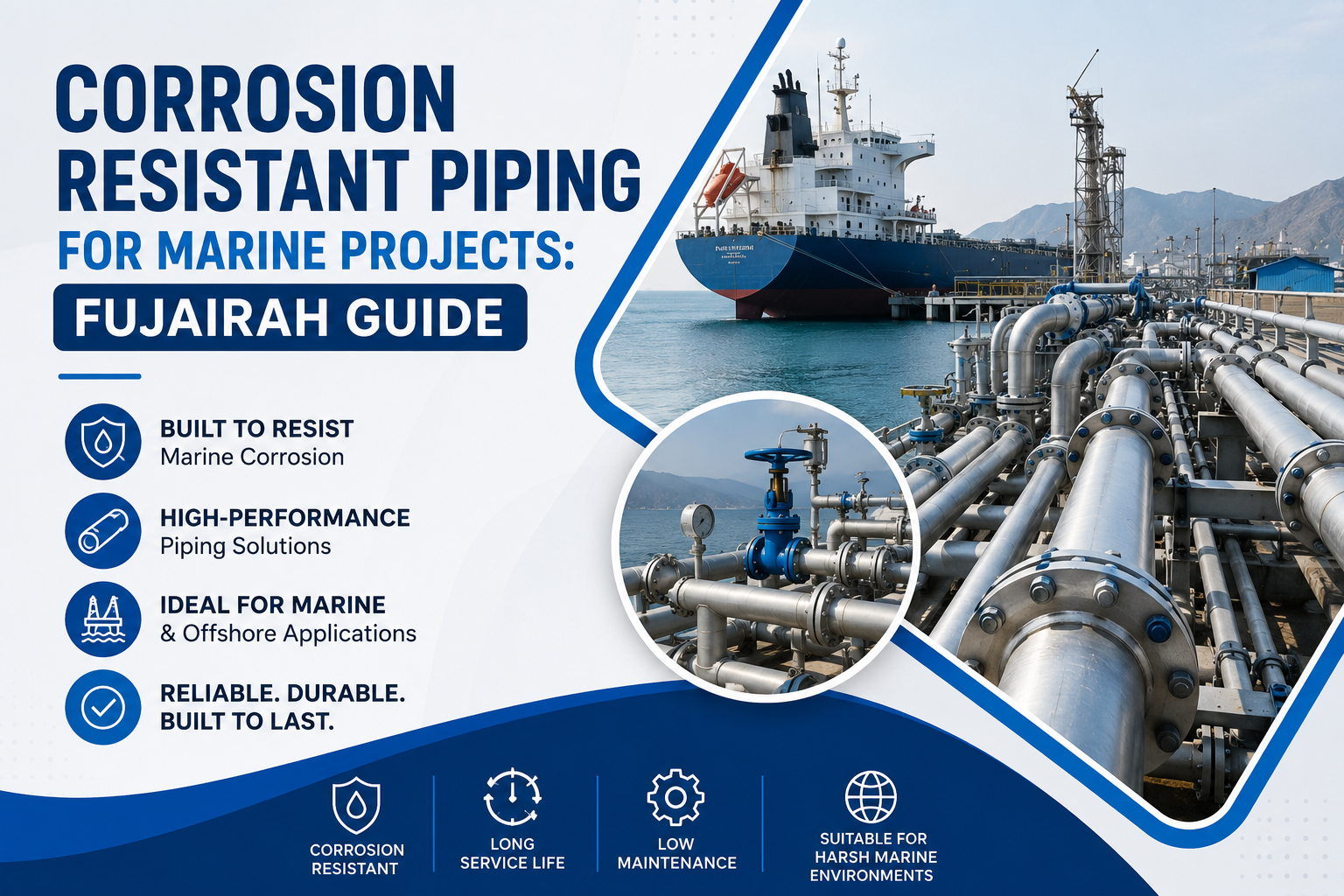
Salt-laden air, constant humidity, and direct seawater exposure make Fujairah’s marine and offshore sector one of the most demanding piping environments in the UAE. Specifying the wrong material here doesn’t just shorten service life — it creates safety risk and expensive premature failure. Getting Corrosion Resistant Piping for Marine Projects right from the design stage is non-negotiable for anyone working in Fujairah’s port, shipbuilding, or offshore infrastructure.
As one of the world’s largest bunkering hubs and a critical node for oil storage and ship repair, Fujairah’s marine sector places extraordinary demands on piping systems that standard onshore specifications simply weren’t built to handle.
This guide breaks down exactly which materials, standards, and selection criteria matter most for marine piping in Fujairah, so your next project is built to last in genuinely harsh maritime conditions.
Why Marine Piping Solutions Fujairah Demands Special Consideration
Fujairah sits on the Gulf of Oman coastline, home to one of the world’s busiest anchorages and a major bunkering and oil storage hub. This concentration of port infrastructure, offshore platforms, and shipbuilding activity means marine piping solutions Fujairah projects require must withstand conditions far more aggressive than typical inland UAE construction.
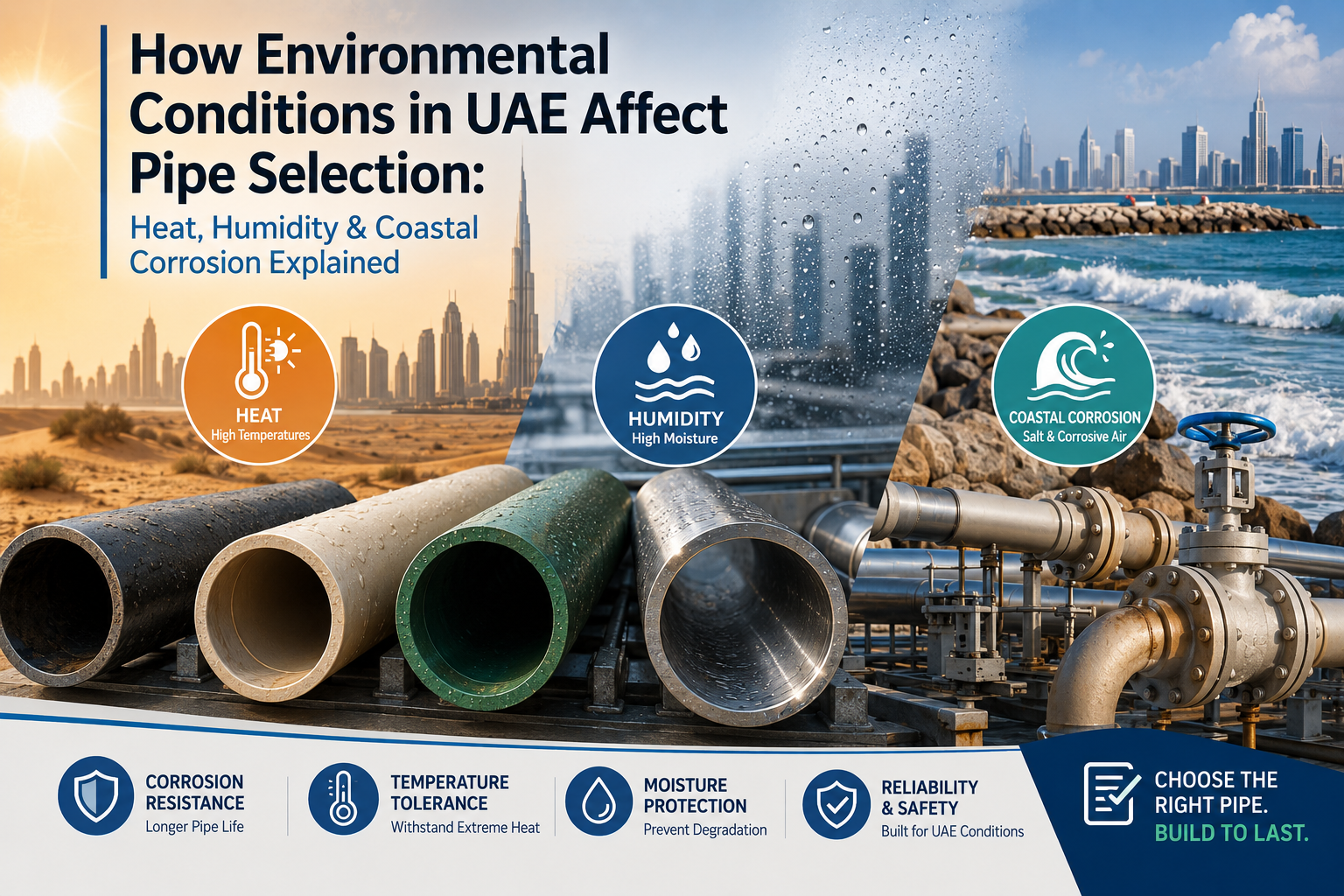
Constant seawater spray, high humidity, and cyclical wet-dry exposure accelerate corrosion dramatically compared to standard onshore environments — a reality that makes material selection the single most important engineering decision on any Fujairah marine project.
As a trusted pipe supplier in Dubai and UAE with fast delivery to Fujairah and all northern emirates, we work directly with EPC contractors and facility operators to specify materials matched to these exact demands.
Corrosion Resistant Pipes UAE: Understanding the Material Hierarchy
Before diving into marine-specific applications, understanding the broader corrosion resistant pipes UAE material hierarchy helps frame why certain grades are non-negotiable for coastal and offshore work.
General Corrosion Resistance Ranking (Lowest to Highest)
- Standard carbon steel — requires coating or cathodic protection in marine environments
- Galvanized steel (GI) — moderate protection, suited for less severe exposure
- Austenitic stainless steel (304/316) — strong general corrosion resistance
- Duplex stainless steel — superior strength and chloride resistance
- Super duplex and specialty alloys — maximum resistance for the most aggressive marine conditions
For coastal areas specifically, our material selection guidance recommends stainless steel grades 316/316L, HDPE, or heavily galvanized materials as the baseline starting point against salt spray and humidity exposure.
Offshore Piping Materials Fujairah: What Platforms Actually Require
Understanding offshore piping materials Fujairah platforms and installations demand requires looking beyond standard coastal specifications toward genuinely marine-grade solutions.
Key Considerations for Offshore Applications
- Continuous seawater immersion or splash-zone exposure
- Higher pressure ratings for process and utility piping
- Resistance to biofouling alongside corrosion resistance
- Compatibility with cathodic protection systems where applicable
Our marine and shipbuilding supply range specifically includes corrosion-resistant grades and pressure-rated materials engineered for shipbuilding, port infrastructure, and offshore platform applications where origin verification and material traceability are standard practice.
Marine Grade Stainless Steel Pipes: The Workhorse Material
For the majority of marine piping applications, marine grade stainless steel pipes represent the most widely specified solution, balancing corrosion resistance with practical cost and availability.
Common Marine-Grade Stainless Steel Options
- Grade 316/316L — the standard baseline for marine and coastal applications, offering strong chloride resistance
- Grade 321 — stabilized grade suited for higher-temperature marine process applications
- Grade 904L — enhanced resistance for more aggressive seawater or chemical exposure
We maintain extensive stainless steel pipe inventory across these grades, serving corrosive environments, high-temperature applications, and marine industries specifically.
Duplex Stainless Steel Piping Marine: The Premium Upgrade
For the most demanding marine applications, understanding duplex stainless steel piping marine projects increasingly specify helps clarify when this premium material grade justifies its higher cost.
Why Duplex Steel Excels in Marine Environments
- Combines austenitic and ferritic microstructure for superior strength and corrosion resistance
- Excellent resistance to chloride-induced stress corrosion cracking, a common failure mode in standard stainless steel exposed to seawater
- Higher mechanical strength allows thinner wall sections while maintaining pressure ratings
- Increasingly specified for critical offshore and shipbuilding applications where failure consequences are severe
Duplex 2205 and Super Duplex 2507 grades are commonly stocked for exactly these demanding marine and offshore requirements.
Seawater Resistant Piping Systems: Design Considerations Beyond Material
Material grade alone doesn’t guarantee performance — understanding complete seawater resistant piping systems design requires attention to several additional factors.
System-Level Design Considerations
- Joint design — welded connections generally outperform threaded joints in marine service
- Cathodic protection compatibility — ensuring material selection works with any planned protection systems
- Flow velocity limits — excessive velocity can cause erosion-corrosion even in resistant materials
- Biofouling management — some systems require periodic cleaning access points designed into the piping layout
A well-designed system considers these factors alongside material selection, rather than assuming premium material alone guarantees long-term performance.
Marine Pipe Fittings Fujairah: Matching Fittings to Pipe Grade
Understanding marine pipe fittings Fujairah projects require ensures your entire piping system maintains consistent corrosion resistance, not just the straight pipe runs.
Fitting Considerations for Marine Applications
- Elbows, tees, and reducers must match the base pipe’s material grade to avoid galvanic corrosion at joints
- Butt-weld fittings generally preferred over threaded connections for critical marine piping
- Full traceability and material certificates should accompany fittings, not just primary pipe
Our comprehensive pipe fittings range includes butt-weld, socket-weld, and threaded fittings across carbon steel, stainless steel, alloy steel, duplex, and super duplex grades — ensuring complete system compatibility for marine projects.
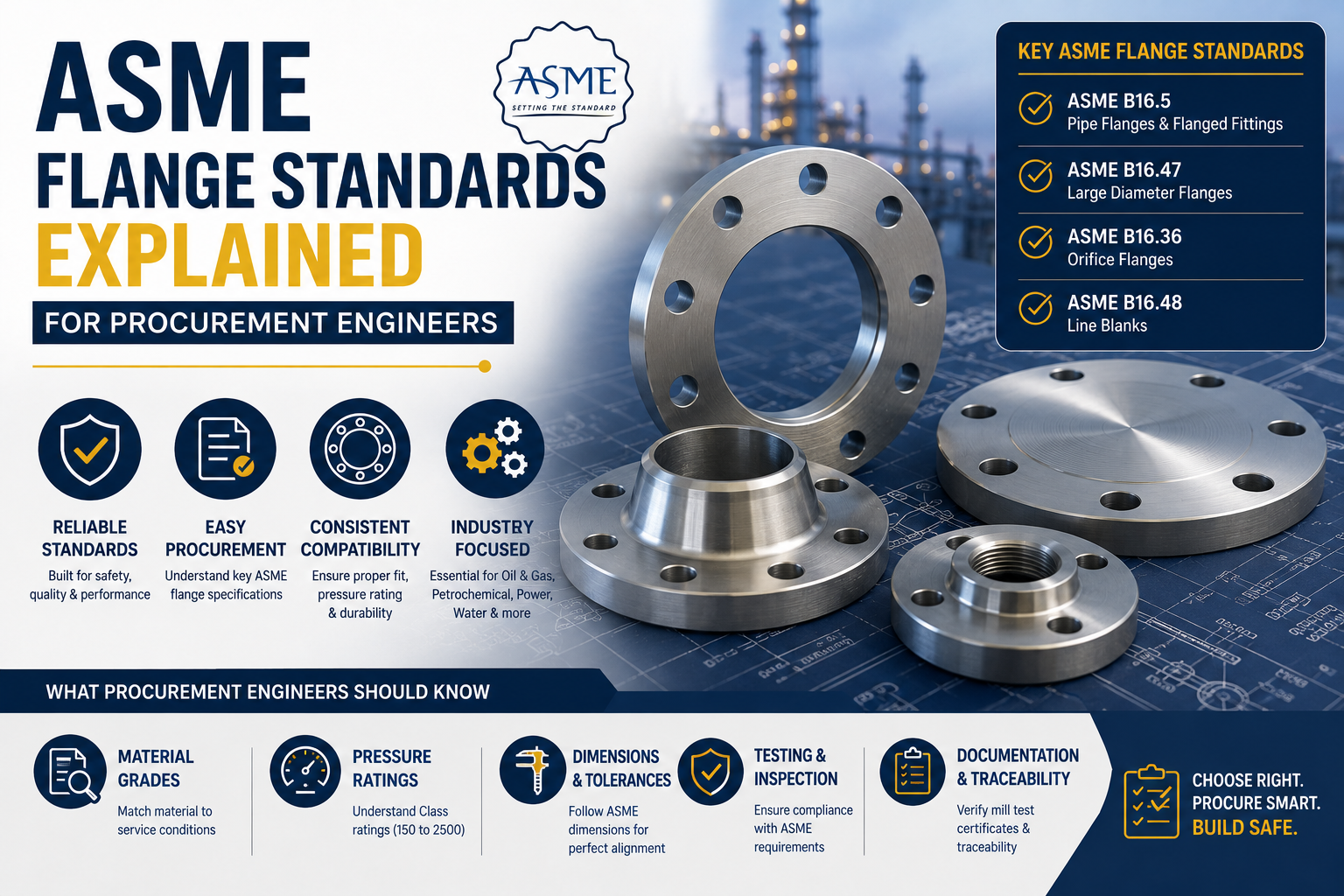
Corrosion Resistant Flanges Marine: Completing the System
Flanged connections present unique corrosion challenges in marine service, making corrosion resistant flanges marine specification just as critical as the pipe itself.
Marine Flange Considerations
- Material grade must match connected pipe to prevent galvanic corrosion
- Gasket selection must account for seawater exposure and temperature cycling
- Lap joint flanges are particularly popular in marine, desalination, and water treatment sectors given their suitability for systems requiring frequent dismantling for inspection
Our flanges supplier services in Sharjah page details our complete range across stainless steel, duplex, and other specialty grades suited to marine flange applications.
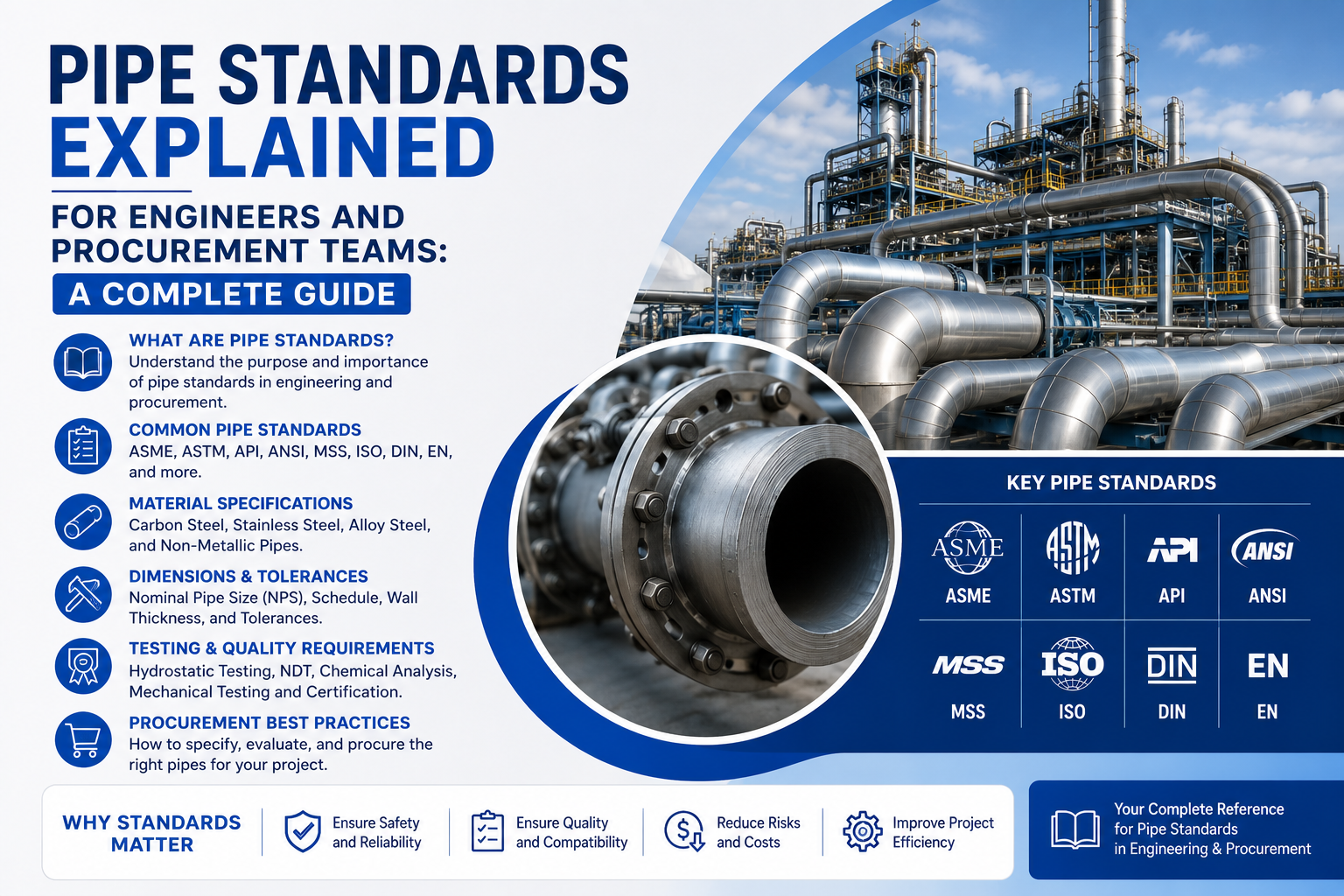
Piping for Offshore Platforms UAE: Regulatory and Standards Framework
Understanding the standards governing piping for offshore platforms UAE projects require ensures compliance across both material specification and documentation requirements.
Key Standards Referenced
- ASME B31.3 — process piping design and construction
- API standards — specific to offshore and wellhead equipment
- ASTM material standards — defining chemical composition and mechanical properties for marine-grade alloys
- DNV/ABS classification requirements — where applicable for classed vessels and offshore structures
Full material traceability, including mill test certificates and heat number verification, is essential documentation for any offshore or marine project in Fujairah’s regulatory environment.
Marine Piping Material Selection: A Practical Decision Framework
Bringing everything together, marine piping material selection for Fujairah projects should follow a consistent evaluation framework rather than defaulting to familiar materials out of habit.
Selection Checklist
- Identify the specific exposure zone (splash zone, immersed, or atmospheric coastal)
- Determine required pressure and temperature ratings for the application
- Evaluate chloride content and any additional chemical exposure factors
- Cross-reference applicable ASME, API, or ASTM standards
- Balance material cost against expected service life in marine conditions
Applying this framework consistently prevents the common mistake of specifying standard onshore materials for genuinely marine-exposed applications.
Anti-Corrosion Coating for Pipes: When Coatings Supplement Material Choice
For applications where premium stainless or duplex grades aren’t specified, understanding anti-corrosion coating for pipes options helps extend service life for more economical base materials.
Common Coating Approaches
- Hot-dip galvanizing — provides a sacrificial zinc layer protecting underlying steel
- Epoxy and specialty coatings — applied for additional protection in splash-zone or buried applications
- Cathodic protection systems — used alongside coatings for comprehensive corrosion management on critical infrastructure
While coatings extend the service life of more economical materials, they require periodic inspection and maintenance — a factor that should be weighed against choosing inherently corrosion-resistant materials from the outset.
Fujairah Port Piping Supplier: What to Look for in a Partner
Choosing the right Fujairah port piping supplier for your marine project involves evaluating more than just material availability.
Key Supplier Evaluation Criteria
- Genuine stock depth across marine-grade stainless, duplex, and specialty alloys
- Full material traceability with mill test certificates and heat number verification
- Fast delivery capability to Fujairah, given the emirate’s distance from Dubai and Sharjah’s main industrial hubs
- Experience specifically with marine, offshore, and shipbuilding project references
From our Sharjah hub, we provide 1-2 day delivery service to Fujairah and all northern emirates, ensuring project timelines aren’t delayed by material availability.
Marine Engineering Piping Standards: Documentation That Matters
Beyond material grade, understanding marine engineering piping standards documentation requirements ensures smooth inspection and project approval processes.
Essential Documentation for Marine Projects
- Material Test Certificates (MTC 3.1/3.2) for every pipe, fitting, and flange
- Full mill traceability with verifiable heat numbers
- Third-party inspection reports where required by project specification
- Compliance certification against ASME, ASTM, API, or DNV/ABS requirements as applicable
For projects working with major operators or classed vessel requirements, insisting on this documentation upfront prevents costly delays during inspection phases.
Saltwater Piping Systems UAE: Lessons From Across the Region
Drawing on broader experience with saltwater piping systems UAE projects beyond Fujairah specifically, several consistent lessons apply across the region’s coastal installations.
Regional Best Practices
- Coastal areas consistently require stainless steel 316/316L, HDPE, or heavily galvanized materials as a baseline, regardless of specific emirate
- Origin verification and traceable mill certificates have become standard practice for marine and offshore procurement, not an optional extra
- Non-China origin material is increasingly specified for projects with classification society or major operator requirements, given origin traceability concerns
Our detailed guide on transitioning to non-China pipe suppliers in the UAE covers exactly why origin verification has become a standard procurement requirement for marine and offshore projects specifically.
Corrosion Resistant Valves Marine: Completing Your System Specification
Rounding out a complete marine piping system, corrosion resistant valves marine applications require matching material grade and design to the same demanding conditions as the piping itself.
Valve Selection Considerations for Marine Service
- Valve body material should match or exceed the connected piping’s corrosion resistance
- Seawater service valves often require specialized trim materials resistant to chloride attack
- Regular maintenance access should be designed into the system given the harsh operating environment
Consistent material specification across pipes, fittings, flanges, and valves ensures your entire marine piping system performs as a coherent, reliable unit rather than having a single weak point undermine an otherwise well-specified installation.
Frequently Asked Questions
1. Why does Fujairah require different piping specifications than inland UAE projects?
Fujairah’s marine and offshore environment involves continuous or cyclical seawater exposure, significantly more aggressive than typical inland conditions, requiring higher corrosion-resistant material grades from the outset.
2. Is duplex stainless steel always necessary for marine piping, or is standard 316 sufficient?
Standard 316/316L often suffices for general coastal and splash-zone applications, while duplex or super duplex grades are typically reserved for the most demanding offshore, high-pressure, or continuous-immersion applications.
3. Can carbon steel be used for marine piping if properly coated?
Yes, with appropriate coating and cathodic protection, carbon steel can serve certain marine applications economically, though this requires more ongoing maintenance than inherently corrosion-resistant materials.
4. What documentation should I require for marine piping materials?
Always require Material Test Certificates (MTC 3.1/3.2), verifiable heat number traceability, and compliance certification against applicable ASME, ASTM, or API standards for any marine or offshore project.
5. How quickly can piping materials be delivered to Fujairah?
From our Sharjah-based inventory, standard delivery to Fujairah typically takes 1-2 days, helping keep marine and offshore project timelines on track.
Final Thoughts
Specifying the right corrosion-resistant piping for marine projects in Fujairah isn’t just a material choice — it directly determines system safety, longevity, and total lifecycle cost in one of the UAE’s harshest operating environments. Matching material grade, documentation, and system design to your project’s specific exposure conditions ensures reliable performance for decades of offshore, port, and shipbuilding operation.
Need certified corrosion-resistant piping for your Fujairah marine project? Visit the Leema Engineering Works to explore our full range of marine-grade stainless steel, duplex, and specialty alloy pipes, fittings, and flanges, or contact our technical team for expert material selection guidance tailored to your project.
Have questions about marine-grade material availability or delivery timelines to Fujairah? Contact our technical sales team directly through the Leema Engineering Works website