Every piping system depends on one small but critical component to stay leak-free, safe, and serviceable — the flange. Whether you’re designing a petrochemical plant in Sharjah or maintaining a water treatment facility in Dubai, choosing the wrong flange type or material can lead to costly failures, downtime, and safety hazards.
This Industrial Flanges Guide is built for engineers, procurement teams, and contractors across the UAE who need a clear, practical understanding of flange types, applications, and material standards — without wading through overly technical manufacturer catalogs.
By the end of this guide, you’ll know exactly which flange fits your project, how to read pressure ratings, and what standards to specify when ordering.
What Are Industrial Flanges and Why Do They Matter?
Industrial flanges are mechanical fittings used to connect pipes, valves, pumps, and other equipment, allowing easy assembly and disassembly for inspection, cleaning, or repair. Unlike welded joints, flanged connections can be opened without cutting the pipe — a major advantage for maintenance-heavy industries like oil and gas, power generation, and water treatment.
A flange assembly typically consists of the flange itself, a gasket, and bolts. Together, they create a pressure-tight seal capable of withstanding extreme temperatures and pressures.
If you’re sourcing flanges for a project in the UAE, working with an established flanges supplier in Sharjah ensures your components meet ASME, ASTM, API, and DIN certifications from day one.
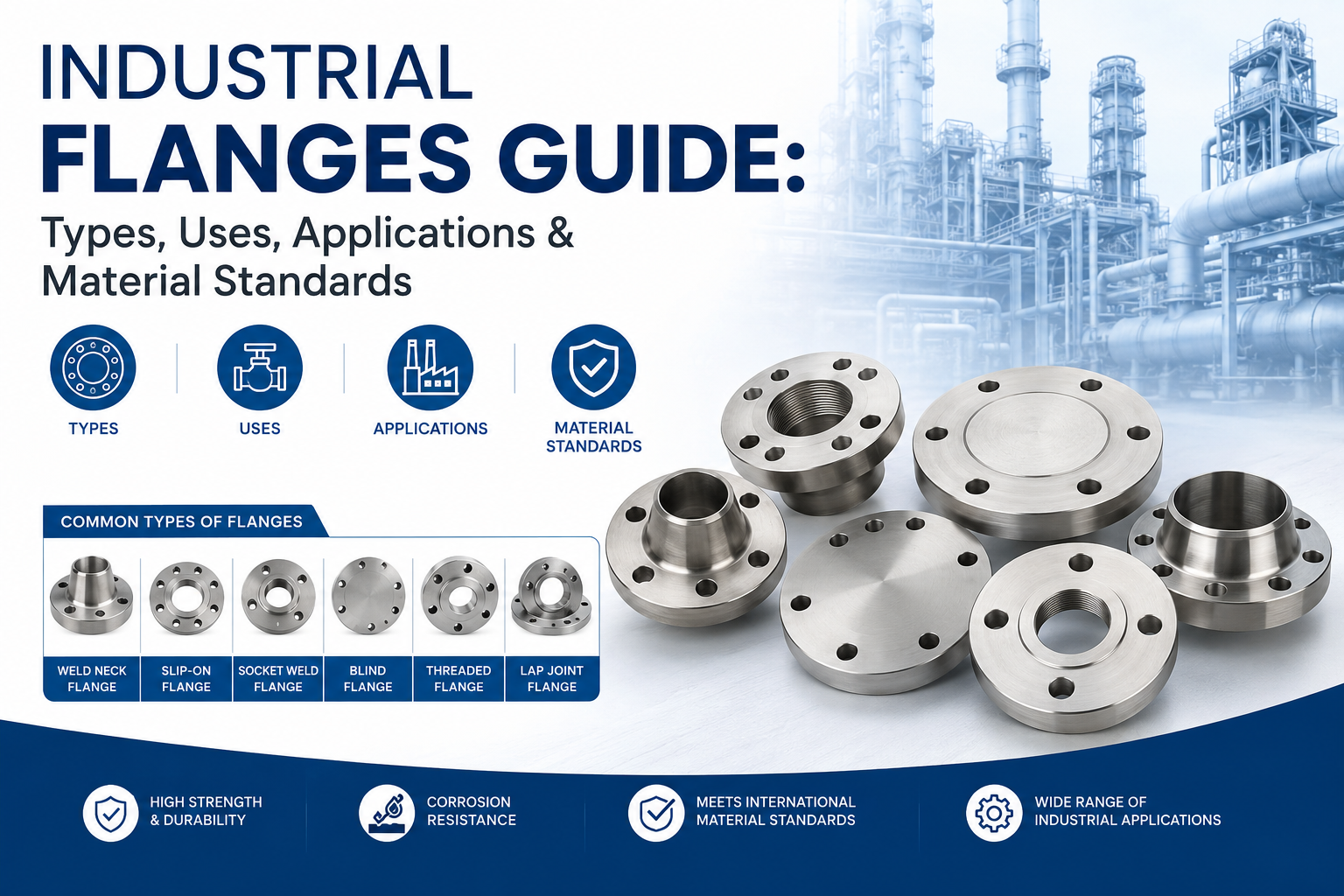
Types of Industrial Flanges
Understanding the types of industrial flanges is the foundation of correct flange selection. Each type serves a different structural and functional purpose.
1. Weld Neck Flange
Designed with a tapered hub that welds directly to the pipe, distributing stress evenly. Ideal for high-pressure, high-temperature applications like refineries and power plants.
2. Slip-On Flange
Slides over the pipe end and is welded both inside and outside. Easier to install and align than weld neck flanges, though slightly less durable under extreme stress — a common flange fitting application for low to moderate pressure systems.
3. Socket Weld Flange
Common in smaller-diameter, high-pressure piping. The pipe fits into a socket and is fillet-welded, giving a smooth internal bore that reduces turbulence.
4. Blind Flange
Used to seal the end of a piping system or vessel opening. Common blind flange uses include pressure testing, system isolation, and future expansion points.
5. Threaded Flange
Connects to pipe via threads instead of welding, making it suitable for low-pressure applications where welding isn’t practical — a key benefit of threaded flange applications in field repairs.
6. Lap Joint Flange
Used with a stub end, allowing the flange to rotate for bolt-hole alignment. Popular in systems requiring frequent dismantling.
7. Orifice Flange
Designed with tapped holes for pressure measurement devices, commonly used in flow metering systems.
Weld Neck Flange vs Slip-On Flange: Which One Do You Need?
This comparison comes up constantly in project specifications, so it deserves its own breakdown.
| Factor | Weld Neck Flange | Slip-On Flange |
|---|---|---|
| Pressure rating | Higher | Moderate |
| Installation | More precise, harder alignment | Easier, faster |
| Cost | Higher | Lower |
| Best for | High-pressure, cyclic loading | General piping, low-pressure |
For critical applications like oil and gas pipelines, weld neck is almost always the safer specification despite the higher upfront cost.
Flange Material Selection Guide
Material choice affects corrosion resistance, strength, and lifespan. A solid flange material selection guide should consider the operating environment, media type, and temperature range.
- Carbon Steel – cost-effective, strong, suited for standard industrial and structural use
- Stainless Steel (304/316) – excellent corrosion resistance, ideal for marine, food-grade, and chemical environments
- Forged Steel – higher strength for demanding pressure applications
- Alloy Steel – used where extreme temperature resistance is required
- Galvanized Steel – zinc coating protects against corrosion in coastal or humid conditions, relevant for UAE’s climate
For coastal projects across Sharjah, Dubai, and Abu Dhabi, stainless steel industrial flanges are frequently specified due to superior resistance to humidity and salt exposure.
Pipe Flange Standards and ANSI Dimensions
Specifying the correct pipe flange standards ensures compatibility across your entire piping system and compliance with international regulations.
Commonly referenced standards include:
- ASME/ANSI B16.5 – governs pipe flanges and flanged fittings up to 24 inches
- API 605 – large diameter carbon steel flanges
- DIN standards – widely used in European-specified projects
- ASTM material standards – define chemical composition and mechanical properties
ANSI flange dimensions specify bolt-hole patterns, outside diameter, and thickness across pressure classes (150#, 300#, 600#, and higher). Always cross-check pressure class against your system’s operating conditions before finalizing an order.
Flange Pressure Rating Chart: Understanding Pressure Classes
A flange pressure rating chart tells you the maximum allowable pressure a flange can handle at a given temperature. Ratings are typically expressed in classes (150, 300, 600, 900, 1500, 2500).
As temperature increases, allowable pressure decreases — this is why material selection and pressure class must be evaluated together, not separately. Always request the manufacturer’s rating chart specific to the material grade you’re ordering.
Flange Gasket Selection
The gasket is what actually creates the seal — the flange just provides the clamping force. Flange gasket selection depends on:
- Media being transported (chemical, steam, water, gas)
- Operating temperature and pressure
- Flange surface finish
Common gasket materials include spiral wound metal gaskets, PTFE, and compressed non-asbestos fiber (CNAF). Mismatched gaskets are one of the leading causes of flange leaks in the field.
High Pressure Flange Systems
High pressure flange systems are common in oil and gas, petrochemical, and power generation industries. These systems typically use weld neck flanges in classes 900 and above, paired with high-strength bolting and metal gaskets to withstand extreme operating conditions.
If your project involves high-pressure piping, our power industry solutions page covers material grades suited for steam, gas, and high-temperature transport.
Flange Installation Guide: Best Practices
A correct flange installation guide should always include:
- Inspect flange faces for damage or debris before assembly
- Align bolt holes precisely to avoid gasket stress
- Use a proper gasket rated for the application
- Tighten bolts in a star (crisscross) pattern, not sequentially
- Apply torque values gradually in multiple passes
- Re-check torque after initial pressure testing
Improper bolt tightening sequence is one of the most common causes of premature gasket failure and leaks.
Industrial Piping Components That Work With Flanges
Flanges rarely work alone. A complete piping system typically includes:
- Pipes and tubing
- Valves (gate, ball, check)
- Fittings (elbows, tees, reducers)
- Gaskets and bolting
- Expansion joints
For projects requiring a full range of industrial piping components, browse our pipe supplier services in Dubai and UAE for integrated sourcing.
Flange Manufacturing Standards and Quality Assurance
Reliable flange manufacturing standards ensure every flange performs as specified under real operating conditions. Look for suppliers who provide:
- Material Test Certificates (MTC 3.1/3.2)
- Compliance with ASME, ASTM, API, and DIN
- Third-party inspection availability
- Full traceability from raw material to finished product
Our fabrication and custom machining services support non-standard flange specifications when off-the-shelf sizes don’t meet project requirements.
Frequently Asked Questions
1. What is the difference between a flange and a fitting?
A flange is a specific type of fitting used to create a bolted, removable connection, while “fitting” is a broader term covering elbows, tees, couplings, and other pipe joining components.
2. Which flange type is best for high-pressure applications?
Weld neck flanges are generally preferred for high-pressure and high-temperature systems due to their tapered hub design, which reduces stress concentration.
3. What material should I choose for coastal or marine environments?
Stainless steel (grade 316) is typically recommended for coastal UAE projects due to its superior resistance to chloride-induced corrosion.
4. How do I know what pressure class flange I need?
Pressure class is determined by your system’s maximum operating pressure and temperature — always cross-reference the manufacturer’s pressure-temperature rating chart for the specific material grade.
5. Can flanges be custom manufactured for non-standard pipe sizes?
Yes, most industrial suppliers offer custom flange manufacturing for unique dimensions, materials, or pressure ratings that fall outside standard catalog sizes.
Final Thoughts
Selecting the right flange isn’t just a procurement decision — it directly affects system safety, longevity, and maintenance costs. Whether you need weld neck flanges for a high-pressure refinery line or stainless steel flanges for a coastal water system, matching the right type, material, and standard to your application is essential.
Need certified flanges for your next project in the UAE? Visit the Leema Engineering Works homepage to explore our full inventory of ASME, ASTM, and API-certified flanges, or contact our technical team for a fast quotation tailored to your specifications.