Specify the wrong flange on a refinery line, and the consequences aren’t cosmetic — they show up as leaks, unplanned shutdowns, and costly rework. That’s exactly why the Weld Neck vs Slip-On Flanges decision deserves careful attention on every oil and gas project across the UAE.
Both flange types have earned their place in industrial piping, but they perform very differently under the pressure, temperature, and cyclic loading conditions typical of upstream, midstream, and downstream operations.
This guide breaks down exactly how these two flange types compare for UAE oil and gas applications, so your next project specification is backed by genuine engineering judgment, not guesswork.
Why Flange Selection Matters for UAE Oil and Gas Projects
The UAE’s energy sector — from offshore platforms to onshore refineries — operates under some of the most demanding piping conditions in the industry: high pressure, corrosive media, extreme heat, and strict international compliance requirements.
Getting weld neck flange oil and gas UAE specifications right from the design stage prevents costly field failures later, since flange selection directly affects joint integrity under thermal cycling and pressure fluctuation.
For projects requiring certified flanges to these standards, our flanges supplier in Sharjah page details our full inventory of ASME, ASTM, API, and DIN-certified products ready for UAE energy sector deployment.
Understanding Weld Neck Flanges: Built for Demanding Conditions
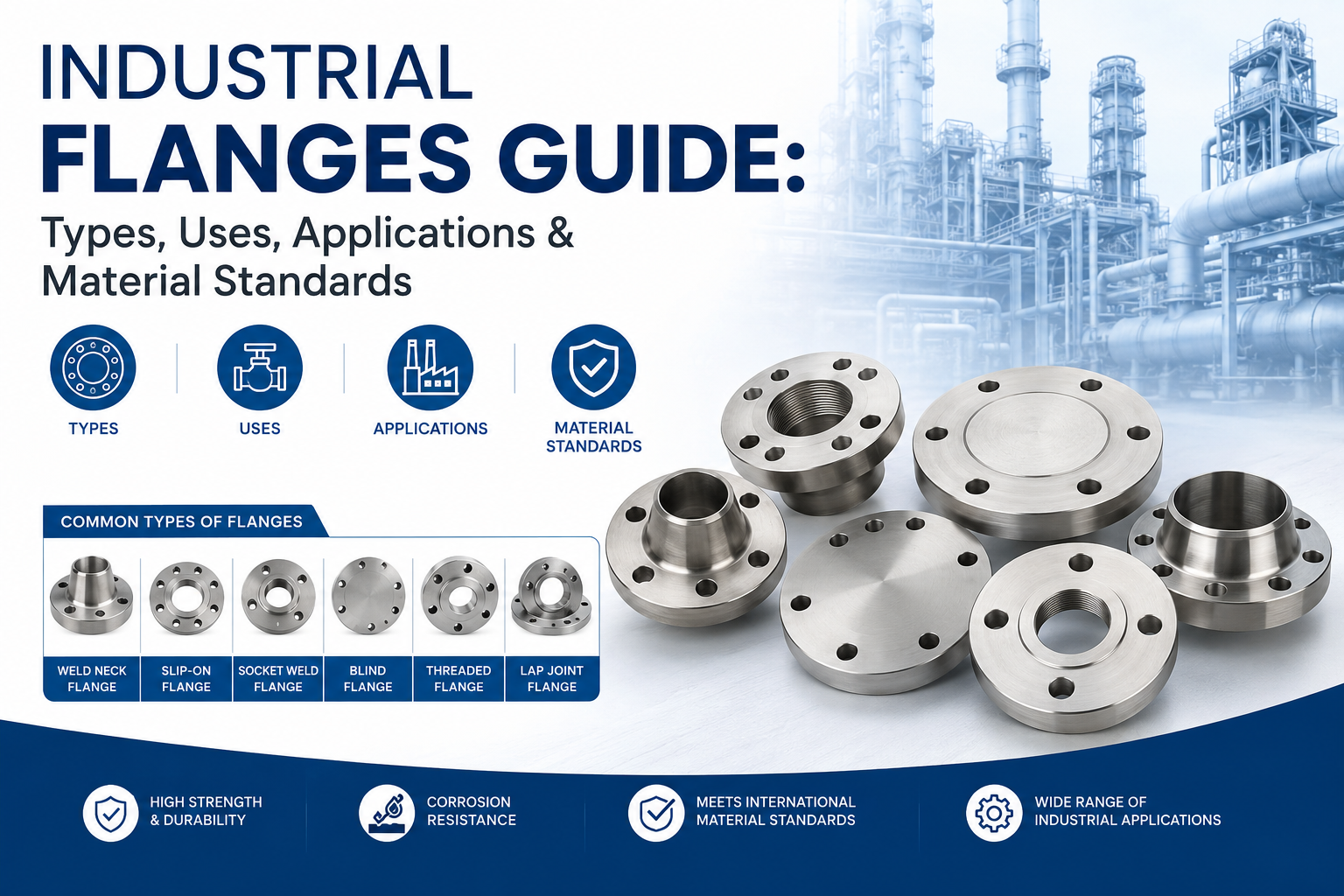
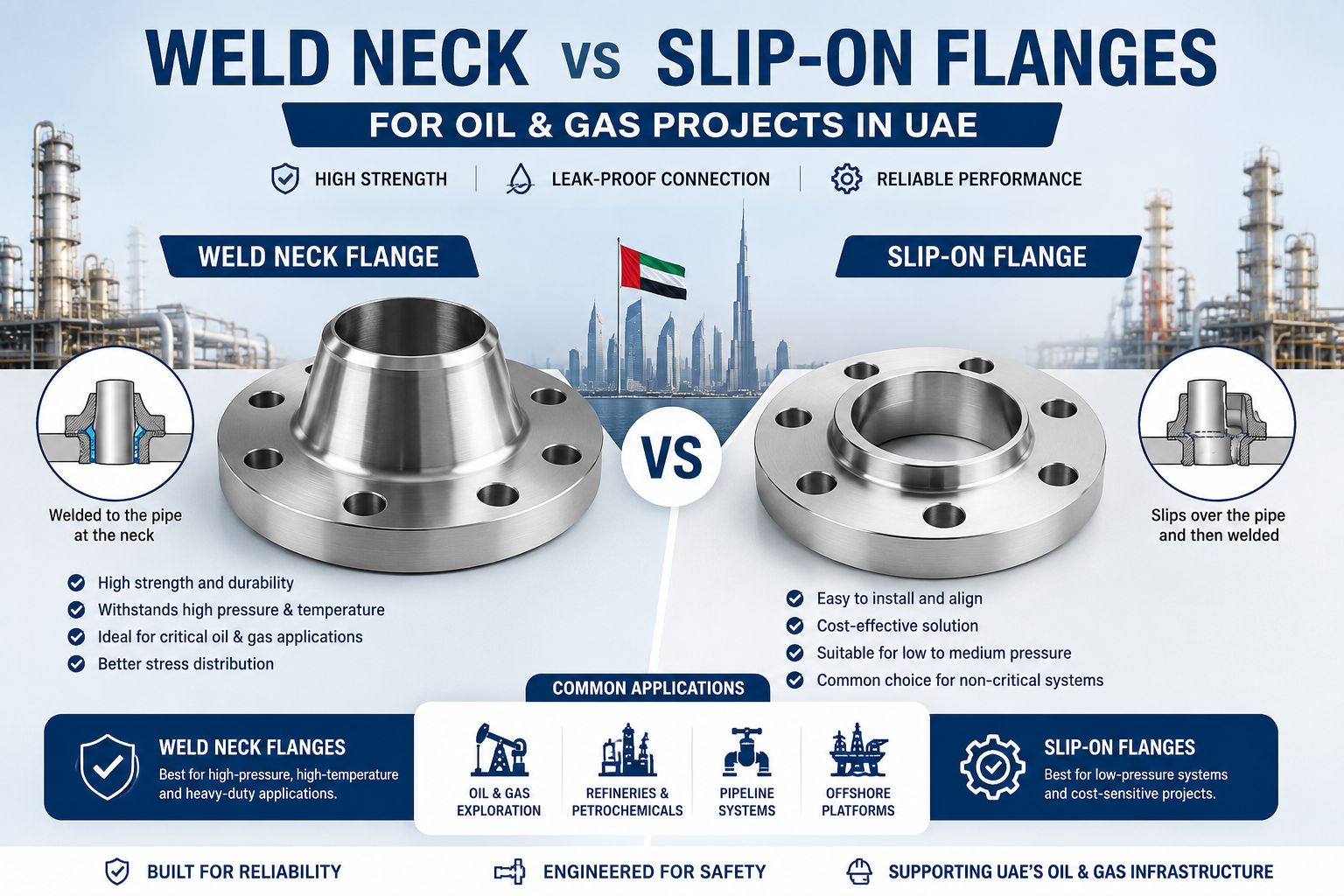
A weld neck flange features a tapered hub that welds directly to the pipe, gradually transitioning wall thickness and distributing mechanical stress evenly across the joint. This design specifically addresses the demanding conditions found in oil and gas piping.
Weld Neck Flange Advantages Disadvantages
Advantages:
- Superior resistance to high pressure and cyclic loading
- Smooth internal bore reduces turbulence and erosion
- Excellent performance under thermal expansion and contraction
- Preferred choice for critical, high-consequence piping systems
Disadvantages:
- Higher material and fabrication cost
- Requires more precise alignment during welding
- Longer installation time compared to simpler flange types
For refinery and pipeline applications where failure isn’t an option, these trade-offs are almost always worth the investment.
Understanding Slip-On Flanges: Simpler, Faster Installation
A slip-on flange slides over the pipe end and is fillet-welded both inside and outside, offering a simpler installation process than the precise beveled welding weld neck flanges require.
Slip-On Flange Advantages Disadvantages
Advantages:
- Faster, simpler installation with less precise alignment required
- Lower material and labor cost
- Easier to fit in tight spaces or field conditions
Disadvantages:
- Lower pressure rating capacity compared to weld neck flanges
- Reduced fatigue resistance under cyclic loading
- Less suitable for high-temperature, high-stress applications
Slip-on flanges remain a practical choice for lower-pressure utility lines and non-critical systems where cost and installation speed take priority.
Weld Neck Flange vs Slip On Flange Pressure Rating: The Core Technical Difference
Understanding weld neck flange vs slip on flange pressure rating differences is central to safe specification on any oil and gas project.
Pressure Rating Comparison
| Factor | Weld Neck Flange | Slip-On Flange |
|---|---|---|
| Typical pressure class range | Up to 2500# and beyond | Generally limited to lower classes |
| Fatigue resistance | High | Moderate to low |
| Thermal cycling tolerance | Excellent | Limited |
| Recommended for | High-pressure, high-temp lines | Low-pressure utility lines |
For UAE oil and gas facilities operating under sustained high pressure — common in gas processing and refinery units — weld neck flanges remain the safer, code-compliant choice in nearly all critical applications.
Best Flange for Oil and Gas Pipelines UAE: Making the Right Call
Determining the best flange for oil and gas pipelines UAE projects require depends heavily on the specific service conditions of each pipeline segment.
Decision Framework
- High-pressure trunk lines and process piping → Weld neck flange
- Low-pressure utility or drainage lines → Slip-on flange may be acceptable
- Cyclic loading or thermal stress expected → Weld neck flange
- Budget-constrained, non-critical systems → Slip-on flange
- Offshore or highly corrosive environments → Weld neck flange with appropriate material grade
Most EPC contractors working on UAE energy projects default to weld neck flanges for anything classified as process-critical piping, reserving slip-on flanges for auxiliary systems only.
Weld Neck Flange vs Slip On Flange Cost: Understanding the Trade-Off
Budget planning requires realistic understanding of weld neck flange vs slip on flange cost differences across a project’s full piping scope.
Cost Considerations
- Material cost — weld neck flanges typically cost more due to the forged tapered hub design
- Fabrication and welding labor — weld neck installation requires more skilled labor and precision
- Long-term maintenance cost — slip-on flanges may require more frequent inspection and replacement in demanding service
- Total cost of ownership — weld neck flanges often prove more economical over the pipeline’s operational lifetime despite higher upfront cost
Rather than comparing unit price alone, EPC contractors should evaluate total lifecycle cost, particularly for pipelines expected to operate for decades under UAE’s demanding climate and pressure conditions.
Flange Selection for Oil and Gas Industry: A Practical Checklist
Bringing everything together, this flange selection for oil and gas industry checklist helps engineers and procurement teams finalize specifications with confidence.
Before Specifying Your Flange, Confirm:
- Maximum operating pressure and temperature for the specific line segment
- Expected thermal cycling or vibration exposure
- Media corrosivity and required material grade
- Applicable pressure class per ASME B16.5 or relevant standard
- Budget constraints balanced against long-term reliability requirements
Systematically working through this checklist — rather than defaulting to familiar flange types out of habit — consistently produces safer, more cost-effective specifications.
Oil and Gas Piping Flange Standards UAE: Compliance Requirements
UAE energy projects must meet strict oil and gas piping flange standards UAE authorities and international bodies require before installation approval.
Key Standards to Reference
- ASME/ANSI B16.5 — governing pipe flanges and flanged fittings
- API 6A and API 605 — specific to wellhead equipment and large diameter flanges
- ASTM material standards — defining chemical composition and mechanical properties
- DIN standards — relevant for European-specified equipment and joint ventures
Compliance documentation, including Material Test Certificates (MTC 3.1/3.2), should accompany every flange shipment for UAE energy sector projects, ensuring full traceability from mill to installation.
API Flange Specifications Oil and Gas: Understanding the Framework
Beyond ASME standards, API flange specifications oil and gas projects frequently reference address wellhead and production equipment specifically, covering requirements beyond standard piping flange codes.
API specifications typically define more stringent testing, material certification, and dimensional tolerance requirements suited to the extreme service conditions found in upstream oil and gas production — always confirm which specification applies to your specific application before finalizing procurement.
ADNOC Flange Specifications: Working With Regional Requirements
Projects tied to ADNOC and other major regional operators often carry additional ADNOC flange specifications requirements layered on top of standard ASME and API codes.
These typically include specific documentation, vendor qualification, and inspection protocols unique to each operator’s internal engineering standards. Always confirm project-specific specification documents directly with the client or EPC contractor, since these requirements can vary by contract and project phase.
Our power industry solutions page details material grades and certification processes suited to high-compliance regional energy projects.
Flange Types for Refinery Piping UAE: Application-Specific Guidance
Refinery environments present some of the most demanding conditions for flange types for refinery piping UAE specification, combining high temperature, corrosive media, and continuous operation.
Refinery-Specific Considerations
- Weld neck flanges are standard for main process lines given their fatigue resistance
- Material selection must account for sour service (H2S-containing media) where applicable
- Gasket selection becomes critical given the combination of heat and chemical exposure
- Regular inspection protocols should be established given continuous, high-stress operation
For refinery projects, flange specification decisions directly impact both safety and operational uptime — under-speccing to save cost often proves far more expensive after installation.
Weld Neck Flange Installation Oil and Gas: Best Practices
Proper weld neck flange installation oil and gas procedures ensure the flange performs as designed under actual operating conditions.
Installation Best Practices
- Verify beveled pipe end preparation matches flange specification precisely
- Use qualified welders certified for the specific material and service conditions
- Perform proper preheat and post-weld heat treatment where required by code
- Conduct non-destructive testing (radiography or ultrasonic) on critical welds
- Verify alignment before final bolt-up to avoid gasket stress
Skipping proper weld qualification or NDT on critical process lines is one of the most common — and costly — mistakes on oil and gas projects.
Slip-On Flange Installation Oil and Gas: Simpler, But Still Critical
While generally simpler, slip-on flange installation oil and gas procedures still require careful attention to avoid premature failure in service.
Key Installation Points
- Proper fillet weld sizing on both inside and outside welds
- Adequate gap allowance between pipe end and flange face per code requirements
- Verification that the application genuinely suits slip-on flange pressure limitations
- Regular inspection given the flange’s lower fatigue resistance under cyclic conditions
Even in lower-pressure applications, proper installation practice remains essential to avoid unnecessary maintenance issues down the line.
High Pressure Flange Selection UAE: When Weld Neck Becomes Mandatory
For genuinely demanding service, understanding high pressure flange selection UAE projects require makes weld neck flanges effectively mandatory rather than optional.
When High-Pressure Selection Becomes Critical
- Gas processing and compression station piping
- Main export pipelines carrying high-pressure hydrocarbons
- Offshore platform piping subject to dynamic loading
- Any system operating in pressure classes 900# and above
In these scenarios, specifying anything other than weld neck flanges typically violates both engineering best practice and applicable code requirements.
Flange Material for Oil and Gas Pipelines: Matching Grade to Service
Beyond flange type, flange material for oil and gas pipelines selection significantly affects long-term performance alongside the weld neck versus slip-on decision.
Common Material Grades
- Carbon steel (A105) — standard for general service, cost-effective
- Low temperature carbon steel (LTCS) — for cryogenic or cold climate applications
- Stainless steel (304/316) — for corrosive or sour service environments
- Alloy steel — for extreme temperature or pressure applications
Material selection should always be evaluated alongside flange type — a correctly chosen weld neck flange in the wrong material grade still risks premature failure in aggressive service conditions.
Flange Supplier for Oil and Gas UAE: Choosing the Right Partner
Ultimately, working with the right flange supplier for oil and gas UAE projects depend on ensures both flange type and material specifications are met with full traceability and compliance documentation.
What to Look For in a Supplier
- Comprehensive certification (ASME, ASTM, API, DIN) across product lines
- Material Test Certificates provided with every shipment
- Experience specifically with regional energy sector projects
- Ability to supply both weld neck and slip-on options across pressure classes
For complete piping system compatibility, our pipe supplier services in Dubai and UAE and services page detail our full capability across flanges, pipes, and custom fabrication for UAE energy projects.
Frequently Asked Questions
1. Can slip-on flanges be used anywhere on an oil and gas pipeline?
No, slip-on flanges are generally limited to lower-pressure, non-critical utility lines; high-pressure process piping typically requires weld neck flanges per code and engineering best practice.
2. Why do weld neck flanges cost more than slip-on flanges?
Weld neck flanges require forged tapered hub construction and more precise, skilled welding during installation, both of which add to material and labor costs compared to simpler slip-on designs.
3. Are weld neck flanges always required for ADNOC-related projects?
Requirements vary by project and specific line service — always confirm project-specific specification documents with the client or EPC contractor, since operator-specific standards can layer additional requirements onto standard codes.
4. What pressure class typically requires weld neck flanges over slip-on?
Pressure classes of 600# and above, particularly in cyclic or high-temperature service, generally require weld neck flanges for adequate fatigue resistance and safety margin.
5. Do slip-on flanges need less rigorous inspection than weld neck flanges?
No, while installation is simpler, slip-on flanges still require proper weld sizing and regular inspection, particularly given their lower fatigue resistance under cyclic loading conditions.
Final Thoughts
Choosing between weld neck and slip-on flanges for oil and gas projects in the UAE isn’t just a cost decision — it directly affects pipeline safety, longevity, and regulatory compliance. Matching flange type and material to your system’s actual pressure, temperature, and service conditions ensures your project performs reliably for decades, not just through initial commissioning.
Need certified weld neck or slip-on flanges for your next UAE energy project? Visit the Leema Engineering Works to explore our full inventory of ASME, ASTM, and API-certified flanges, or contact our technical team for expert specification guidance tailored to your project.