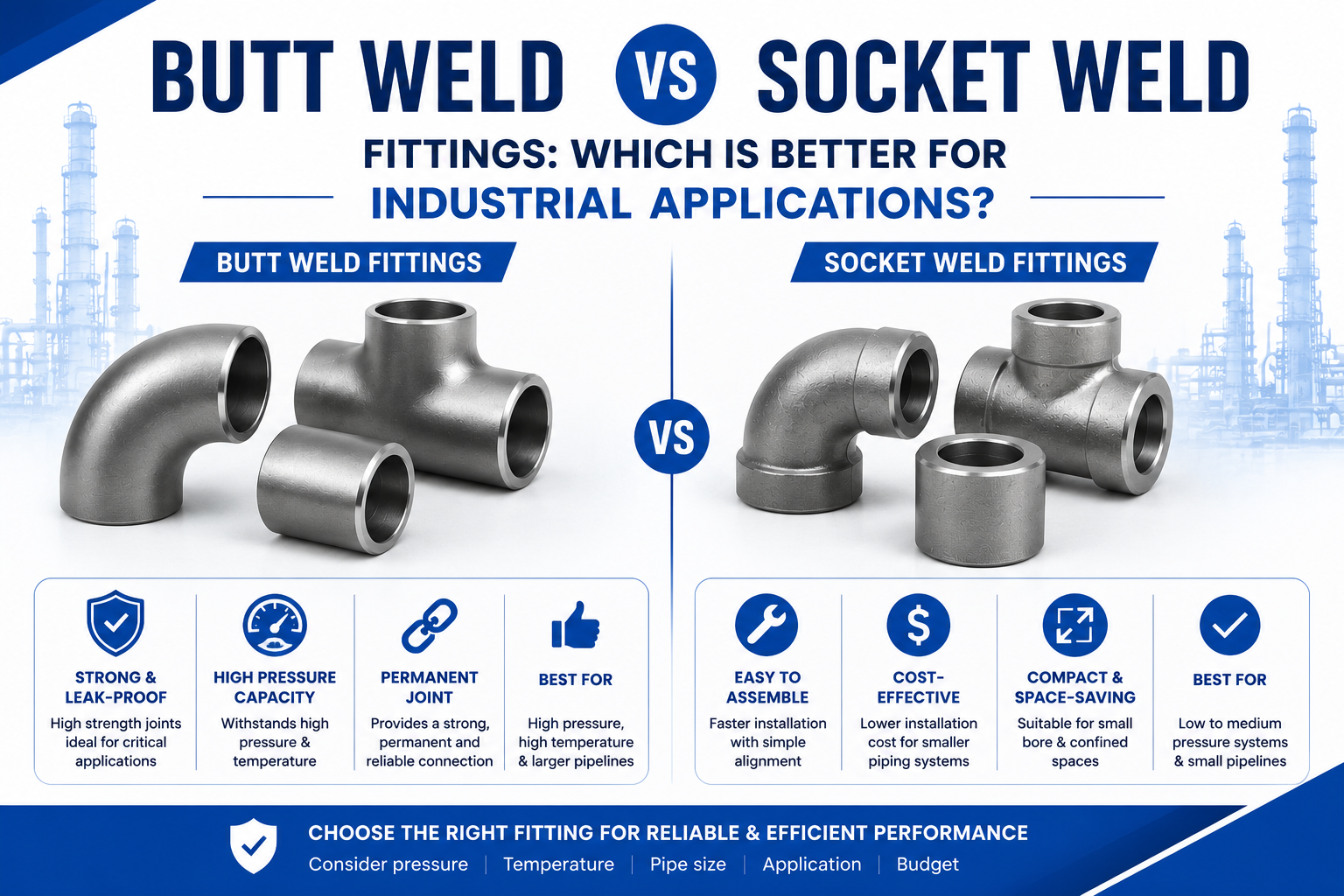
Specifying the wrong connection type on an industrial piping system isn’t a minor documentation error, it can mean a mismatch that fails inspection, or worse, fails under actual operating pressure. Understanding butt weld vs socket weld fittings correctly starts with recognizing that these aren’t interchangeable options, they’re governed by different ASME standards, suited to fundamentally different pipe sizes and pressure conditions.
This guide breaks down exactly how these two connection types compare, so procurement managers, engineers, and contractors across industrial, construction, and oil and gas sectors can specify with confidence rather than defaulting to habit or a supplier’s default recommendation.
Difference Between Butt Weld and Socket Weld: The Core Distinction
Understanding the difference between butt weld and socket weld starts with how each joint is physically formed. Butt weld fittings connect end-to-end with the pipe, beveled edges meeting flush to create a full-penetration groove weld that essentially fuses the fitting and pipe into a single continuous piece of metal. Socket weld fittings work differently, the pipe end slides into a recessed socket within the fitting, and a fillet weld joins the pipe’s outer diameter to the fitting face, without requiring any beveling beforehand.
This structural difference explains nearly everything else that separates the two: strength, flow characteristics, corrosion behavior, and the size ranges each is actually rated for.
Socket Weld Fittings Industrial Use: Where This Type Excels
Socket weld fittings industrial use commonly favors are governed by ASME B16.11, and are generally limited to smaller-bore piping, typically NPS 2 inches and below, with pressure ratings available in Class 3000, 6000, and 9000. The socket design offers genuine practical advantages for small-bore work: easier alignment since the socket itself guides the pipe into position, no beveling requirement, and no risk of weld metal protruding into the internal bore, which matters for systems that must remain perfectly clean internally.
The trade-off is a known weak point called the expansion gap, a small 1.5mm space intentionally left between the pipe end and the socket base to accommodate thermal expansion during welding, which can collect debris or moisture and create a localized corrosion risk over time in certain services.
Pipe Fitting Types Comparison: Where Butt and Socket Weld Fit In
Understanding the broader pipe fitting types comparison helps position butt weld and socket weld correctly within the full picture. Beyond these two welded connection types, threaded fittings, also governed by ASME B16.11, serve utility services like compressed air, nitrogen, or water at lower pressure classes, while flanged connections handle situations requiring disassembly for maintenance. Butt weld and socket weld specifically address permanent, welded connections across the small-to-large bore spectrum most industrial and process piping actually requires.
Butt Weld Fittings for Oil and Gas: Why This Sector Favors Them
Butt weld fittings for oil and gas applications are frequently mandated, not simply preferred, due to the sector’s demanding pressure, temperature, and inspection requirements. Governed by ASME B16.9, butt weld fittings are generally used for NPS 2 and larger, offering a full-penetration weld as strong as the pipe itself, along with a smooth internal flow path free of the crevice and flow restriction socket weld connections introduce at the joint.
Critically, butt weld joints support radiographic (RT) and ultrasonic (UT) inspection, testing methods frequently mandated by project specifications or governing piping codes for critical hydrocarbon service, a requirement socket weld’s fillet weld design cannot satisfy in the same way.
Which Pipe Fitting Is Stronger: Butt Weld vs Socket Weld Strength
Answering which pipe fitting is stronger comes down to a documented engineering difference: socket weld fittings generally offer roughly half the strength of an equivalent butt weld connection, since the fillet weld geometry inherently creates stress concentration points that butt welding’s full-penetration joint avoids. This is precisely why butt weld remains the standard for high-pressure, high-temperature, and cyclic-load systems like steam lines and process headers, where repeated pressure loading can propagate fatigue cracks at a socket weld’s stress points over time.
Best Pipe Fittings for Industrial Projects: A Sizing-Based Decision
Determining the best pipe fittings for industrial projects generally comes down to a straightforward sizing boundary. Below NPS 2 inches, socket weld (or threaded, for lower-pressure utility service) is the standard, cost-effective choice. Above NPS 2 inches, butt weld fittings per ASME B16.9 become mandatory in most project specifications, since forged socket weld fittings simply aren’t manufactured or rated for larger bore sizes in the same way.
This size-based rule of thumb, rather than pressure rating alone, is typically the first filter engineers apply when specifying connection type for any given line.
Socket Weld vs Butt Weld Pressure Rating: Understanding the Classification Systems
A key technical distinction in socket weld vs butt weld pressure rating comes down to how each standard defines pressure capacity. ASME B16.11 socket weld fittings use a fixed class system, Class 2000, 3000, 6000, and 9000, independent of pipe schedule. ASME B16.9 butt weld fittings, by contrast, inherit their pressure rating directly from the matching pipe schedule, meaning a Schedule 80 butt weld fitting carries the same rating as Schedule 80 pipe.
Understanding this distinction matters when cross-referencing project specifications, since confusing these two classification systems can lead to a genuinely serious mismatch between what’s specified on paper and what’s actually installed in the field.
Pipe Fitting Standards ASME: What Governs Each Type
Both connection types trace back to clearly defined pipe fitting standards ASME publishes: ASME B16.9 for butt weld fittings, covering dimensional and tolerance requirements for factory-made wrought fittings across the full NPS range, and ASME B16.11 for socket weld and threaded forged fittings, covering the smaller NPS 1/8 to NPS 4 range. Confirming that your project’s governing specification explicitly references the correct standard, rather than assuming generic “industrial grade” language covers compliance, protects your project against inspection or commissioning issues later.
Industrial Pipe Fittings Supplier: What to Look For
Choosing the right industrial pipe fittings supplier means confirming genuine documentation capability, not just competitive pricing. A reliable supplier should readily provide material test certificates, dimensional compliance documentation against the relevant ASME standard, and clear guidance on which fitting type genuinely suits your specific size and pressure requirements. Working with Leema Engineering’s pipe fittings range alongside their broader oil and gas sector supply experience helps ensure your specification is backed by suppliers who understand both the technical standards and the documentation demands specific to industrial projects.
Welded Pipe Fittings Comparison: A Quick Decision Summary
Bringing this welded pipe fittings comparison together into a practical summary:
- Size: Socket weld typically NPS 2 and below; butt weld standard for NPS 2 and above
- Strength: Butt weld offers roughly double the strength of an equivalent socket weld joint
- Inspection: Butt weld supports RT/UT radiographic testing; socket weld relies on visual or MPI inspection
- Installation: Socket weld is faster and easier to align; butt weld requires beveling and more skilled welding
- Best fit: Socket weld for small-bore, static, moderate-pressure service; butt weld for high-pressure, high-temperature, or code-mandated critical service
Reviewing your project’s exact pressure, temperature, and inspection requirements against this summary before finalizing your order helps avoid a costly mismatch discovered only during inspection or commissioning.
Frequently Asked Questions
1. What size pipe determines whether I need butt weld or socket weld fittings? The general boundary is NPS 2 inches; socket weld fittings are typically used at or below this size, while butt weld fittings become the standard, and often mandatory, choice above it.
2. Are socket weld fittings weaker than butt weld fittings? Yes, socket weld connections generally offer roughly half the strength of an equivalent butt weld joint, due to the fillet weld’s inherent stress concentration compared to butt weld’s full-penetration joint.
3. Why do oil and gas projects often require butt weld fittings specifically? Butt weld fittings support radiographic and ultrasonic inspection methods frequently mandated for critical hydrocarbon service, and their smooth internal bore avoids the crevice corrosion risk associated with socket weld connections.
4. What is the expansion gap in a socket weld fitting? It’s a small, intentional 1.5mm gap left between the pipe end and the socket base to accommodate thermal expansion during welding, though this gap can also collect debris and create a localized corrosion risk over time.
5. Do butt weld and socket weld fittings follow the same pressure rating system? No, socket weld fittings under ASME B16.11 use a fixed class system independent of pipe schedule, while butt weld fittings under ASME B16.9 inherit their pressure rating from the matching pipe schedule.
Final Thoughts on Butt Weld vs Socket Weld Fittings
Choosing correctly between butt weld vs socket weld fittings comes down to matching pipe size, pressure conditions, and inspection requirements to the standard actually governing your application, ASME B16.9 or B16.11, rather than defaulting to whichever fitting type is more familiar or readily available. Getting this specification right from the outset protects both project safety and compliance throughout inspection and commissioning.
Leema Engineering Works Baniyas Najda Street, Al Danah, Zone 1, Abu Dhabi, United Arab Emirates Phone: +971 6 533 8167 / +971 50 425 1818 | Email: sales@leemaeng.com