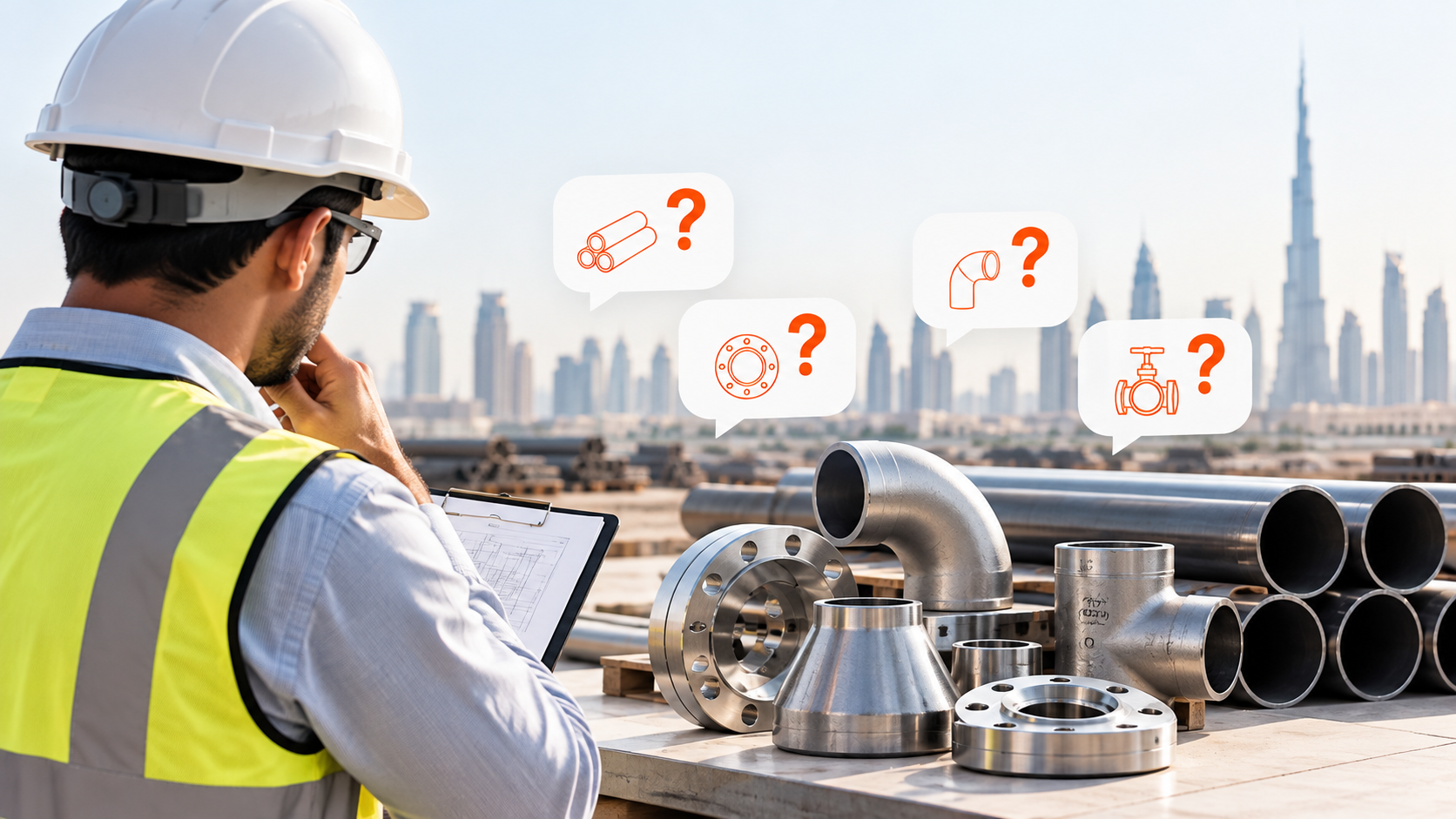
This FAQ pipes fittings flanges UAE guide answers the questions that engineers, procurement managers and EPC contractors ask before raising a purchase order. A wrong grade, a missing certificate or a mismatched flange rating can stall a site for weeks. Clear answers up front prevent that.
The guide reflects the checks buyers run with an experienced pipe supplier in Dubai and UAE. It covers oil and gas, power, marine and construction projects. Leema Engineering Works is an ISO 9001-2015 certified stockist with more than 50 years in the trade, and it supports these buyers from Sharjah and Abu Dhabi.
Why a FAQ Pipes Fittings Flanges UAE Checklist Saves Time
Material mistakes are expensive. Re-ordering also pushes back hydrotests, welding schedules and commissioning dates.
A structured FAQ pipes fittings flanges UAE checklist helps design engineers, buyers and site managers work from the same questions:
- What service conditions apply: pressure, temperature and fluid?
- Which standards does the project specification call for?
- Which documents must arrive with the material?
- How fast must stock reach the site?
Settle these four points first, and most quotation delays disappear.
Pipe Questions in a FAQ Pipes Fittings Flanges UAE Guide
Which pipe material suits oil and gas piping materials requirements?
For high-pressure hydrocarbon lines, carbon steel pipes UAE projects commonly specify include ASTM A106 Grade B seamless pipe and API 5L line pipe. For corrosive or hygienic duty, stainless steel pipe to ASTM A312 is the usual choice. Marine and water-treatment jobs often add duplex or galvanised options.
Non-metallic systems work differently. PVC, CPVC, HDPE and PPR suit plumbing, irrigation and low-pressure utilities. Match the material to the fluid first. Price comes second.
How do I read pipe schedule and pressure rating?
Schedule sets wall thickness, and wall thickness drives pressure capacity. Calculate the required thickness from design pressure, temperature and corrosion allowance. Then choose the nearest standard schedule, such as SCH 40 or SCH 80.
Never choose by diameter alone. Two pipes with the same outside diameter can differ widely in strength.
Should I buy seamless and welded pipes interchangeably?
No. Seamless pipe is preferred for high pressure and high temperature. Welded pipe (ERW or SAW) suits lower-pressure and large-diameter lines, often at a lower cost. Check what your specification allows before comparing prices.
Fittings: Standards, Types and Compatibility
Which standards should a pipe fittings supplier in Sharjah follow?
Butt-weld fittings follow ASME B16.9. Socket-weld and threaded fittings follow ASME B16.11. Dimensions must match the pipe schedule, or the weld bevels will not line up on site.
A dependable pipe fittings supplier in Sharjah and across the UAE states the standard, grade and schedule on every quotation. If a quote omits them, ask before you accept it.
Which fitting type is best for my line?
- Butt-weld elbows, tees and reducers: permanent, high-integrity process lines.
- Socket-weld fittings: small-bore, high-pressure lines.
- Threaded fittings: utility and instrument lines where disassembly may be needed.
- Compression and brass fittings: plumbing and instrumentation.
Flanges: Class, Face Type and Material
How do I match flange class to my pipe?
Flange class (150, 300, 600, 900, 1500 or 2500) must suit the design pressure at operating temperature. ASME B16.5 flanges cover sizes up to NPS 24, while ASME B16.47 covers larger sizes.
Allowable pressure falls as temperature rises. Always check the pressure–temperature tables, not the nominal class alone.
Which flange type and material should I order?
- Weld neck: best for high-stress, high-pressure service.
- Slip-on: easier alignment and lower cost.
- Blind: closes line ends and vessel openings.
- Socket-weld and threaded: small-bore and no-weld situations.
Face type matters as well. Raised face (RF), flat face (FF) and ring type joint (RTJ) are not interchangeable. Corrosive or offshore duty often calls for stainless steel flanges UAE suppliers can certify, while general process lines use forged carbon steel. Leema stocks both through its industrial flanges range.
Gaskets, studs and nuts must match the flange face and class too.
Documents Every FAQ Pipes Fittings Flanges UAE Buyer Should Request
Which certificates are required?
Ask for material test certificates (MTCs) to EN 10204 3.1 as a baseline. Use 3.2 when a third-party inspector must witness testing. These documents show chemical composition, mechanical properties and heat numbers.
Depending on the specification, also request:
- Positive material identification (PMI) reports
- Hydrostatic test records
- NDT reports
- NACE MR0175 / ISO 15156 compliance for sour service
Does country of origin matter?
Sometimes. Some project specifications restrict origin, so confirm this before ordering. Leema Engineering Works positions itself as a non-China stockist for such requirements.
Finally, check that heat numbers on the material match the certificates. Traceability protects you during audits.
Lead Times, Stock and Bulk Orders Across the UAE
How quickly can material reach my site?
Stock availability is the biggest factor. Leema holds warehouse stock in Sharjah and Abu Dhabi, and delivers to Dubai, Ajman, Ras Al Khaimah, Fujairah and Umm Al Quwain. Buyers planning oil and gas work in Abu Dhabi can also read why Mussafah is Abu Dhabi’s industrial pipe hub for sourcing.
How do I request bulk pipe procurement UAE quotations?
Send a clear material take-off so the supplier can quote accurately:
- List size, schedule, grade and standard for each item.
- State the quantity and any alternates you accept.
- Specify required certificates and inspection.
- Add the delivery location and required date.
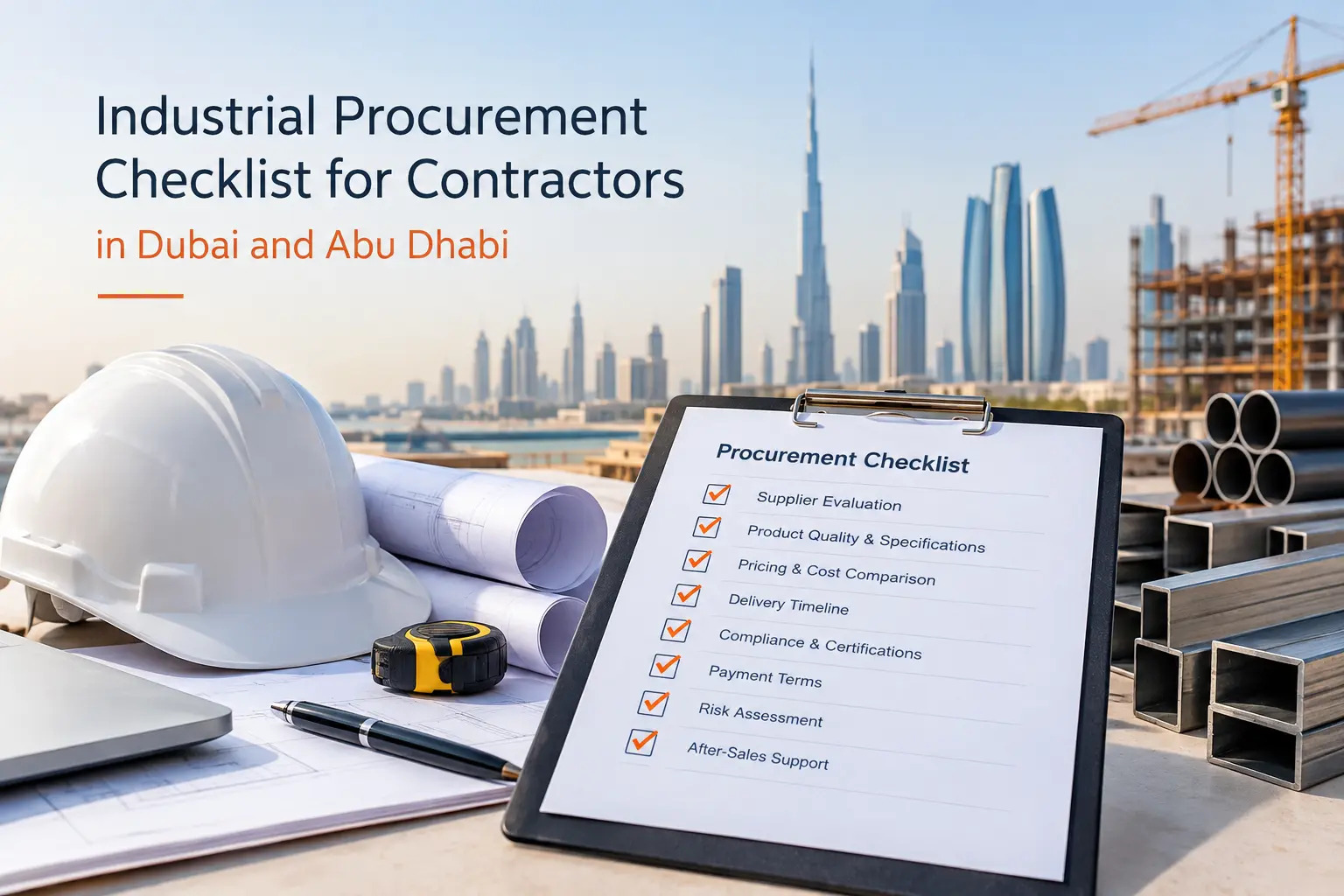
Complete requests get faster, more accurate pricing. This is the practical value of any FAQ pipes fittings flanges UAE checklist: it turns vague enquiries into quotable orders.
FAQ Pipes Fittings Flanges UAE: Quick Answers
1. Which pipe grade is most common for oil and gas projects?
ASTM A106 Grade B and API 5L are widely used for carbon steel lines. Your design basis and corrosion allowance make the final decision.
2. Do I need certificates for every order?
For process and pressure piping, yes. Treat MTCs as mandatory, and use this FAQ pipes fittings flanges UAE answer as your default rule.
3. Can one supplier provide pipes, fittings and flanges together?
Yes. A single source improves compatibility and simplifies documentation, which is why many EPC teams consolidate orders.
4. How do I verify a flange rating?
Check the class marking, material grade and heat number against the MTC. Then confirm the pressure–temperature rating at your design temperature.
5. Do you deliver across all emirates?
Yes. Leema delivers across the UAE from its Sharjah and Abu Dhabi locations.
Final Thoughts on FAQ Pipes Fittings Flanges UAE Buying
Smart purchasing starts with the right questions. Confirm service conditions, standards, documents and delivery needs before you compare prices. That discipline protects both budget and schedule.
Use this FAQ pipes fittings flanges UAE guide as a working checklist for your next enquiry. If you want a second opinion on a specification or a fast quotation, the Leema team is ready to help.
Leema Engineering Works
Industrial Area 2, 27th Street (Old BMW Rd), Sharjah, United Arab Emirates
Abu Dhabi: Baniyas Najda Street, Al Danah, Zone 1
Phone: +971 6 533 8167 | +971 50 425 1818
Email: sales@leemaeng.com