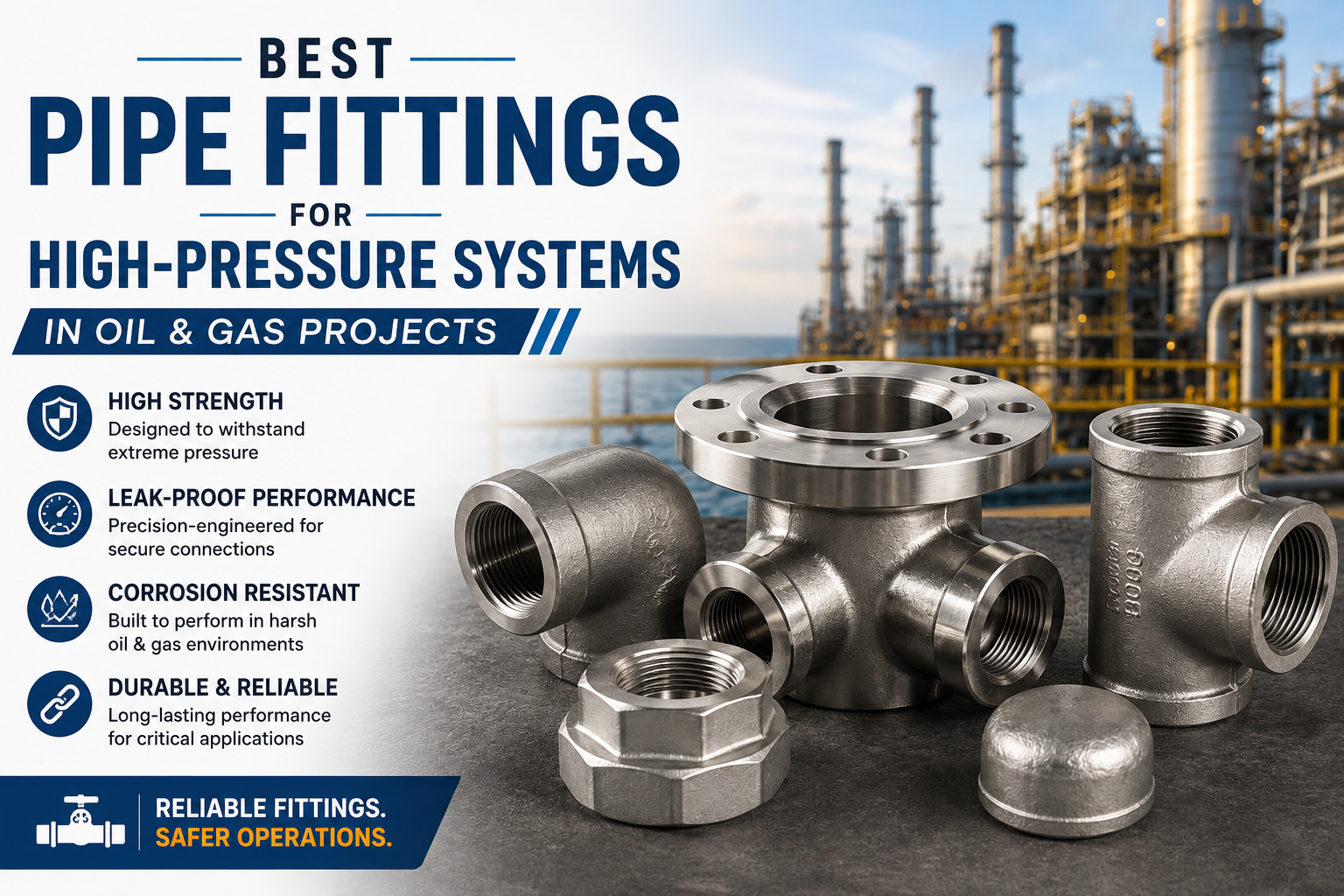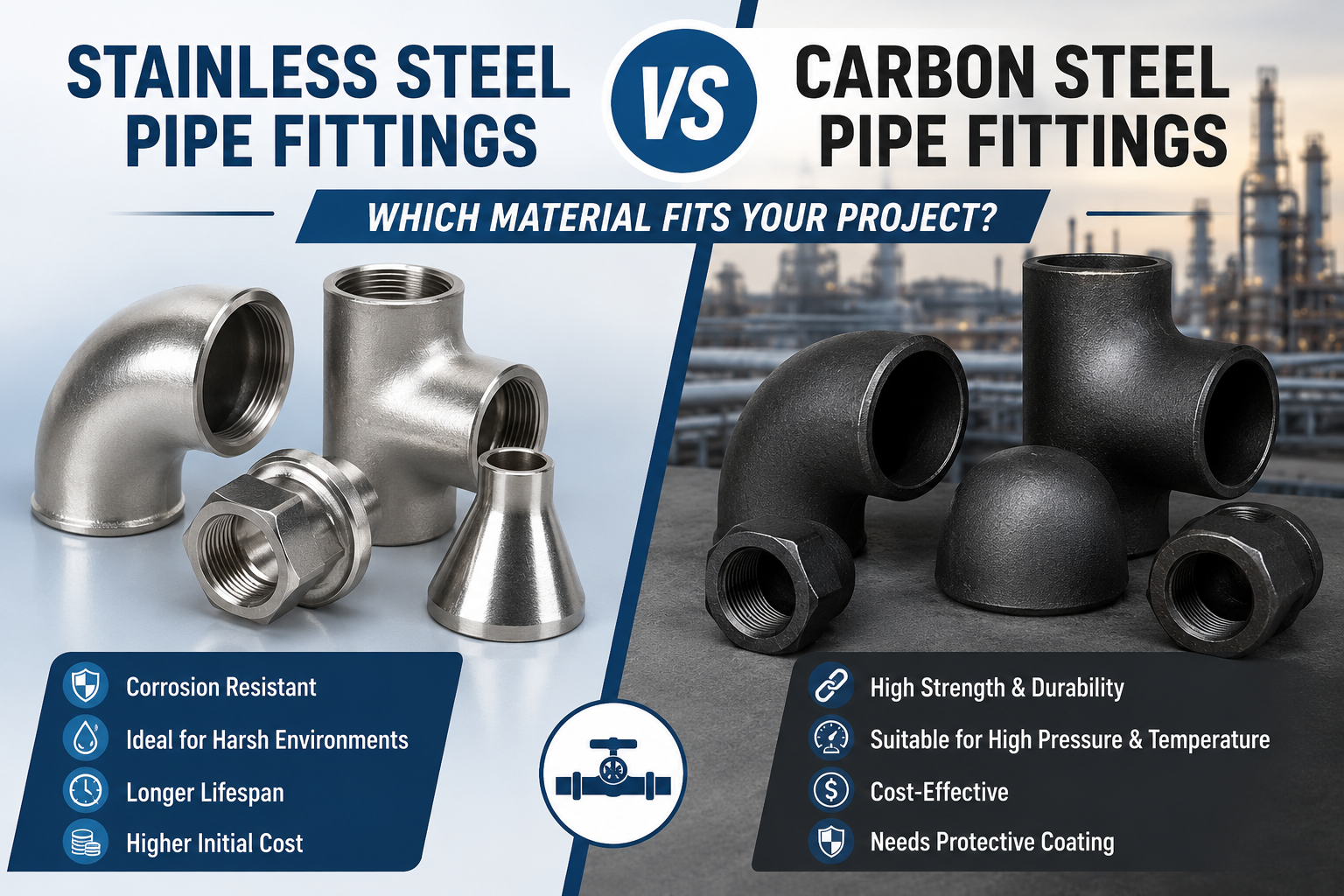
Every piping system is only as reliable as the fittings holding it together, and every fitting is only as reliable as the pipe fitting standards it is manufactured against. For project engineers, piping designers, and QA/QC teams working across oil & gas, petrochemical, and process plants in the UAE, a single mismatched fitting specification can mean a failed hydrotest, a rejected material certificate, or a shutdown months into operation. This guide walks through the pipe fitting standards that govern dimensions, materials, pressure classes, and connection types, so you can specify with confidence on your next EPC package.
Why Pipe Fitting Standards Matter in Piping Design
Pipe fitting standards exist to guarantee that a fitting made by one manufacturer will interchange safely with pipe, valves, and flanges made by another. Without them, piping design standards would collapse into guesswork, and interoperability across global supply chains would be impossible.
For EPC and procurement professionals, standards compliance is not optional. Client specifications, third-party inspection agencies, and regulatory bodies in the oil & gas and petrochemical sectors all reference specific codes by number. Getting the code wrong on a material requisition can delay an entire package.
Key Bodies Behind Pipe Fitting Standards: ASME, ANSI, and ASTM
Three organizations dominate industrial piping specifications, and understanding how they relate is fundamental to reading any fitting datasheet correctly.
ASME Pipe Fitting Standards
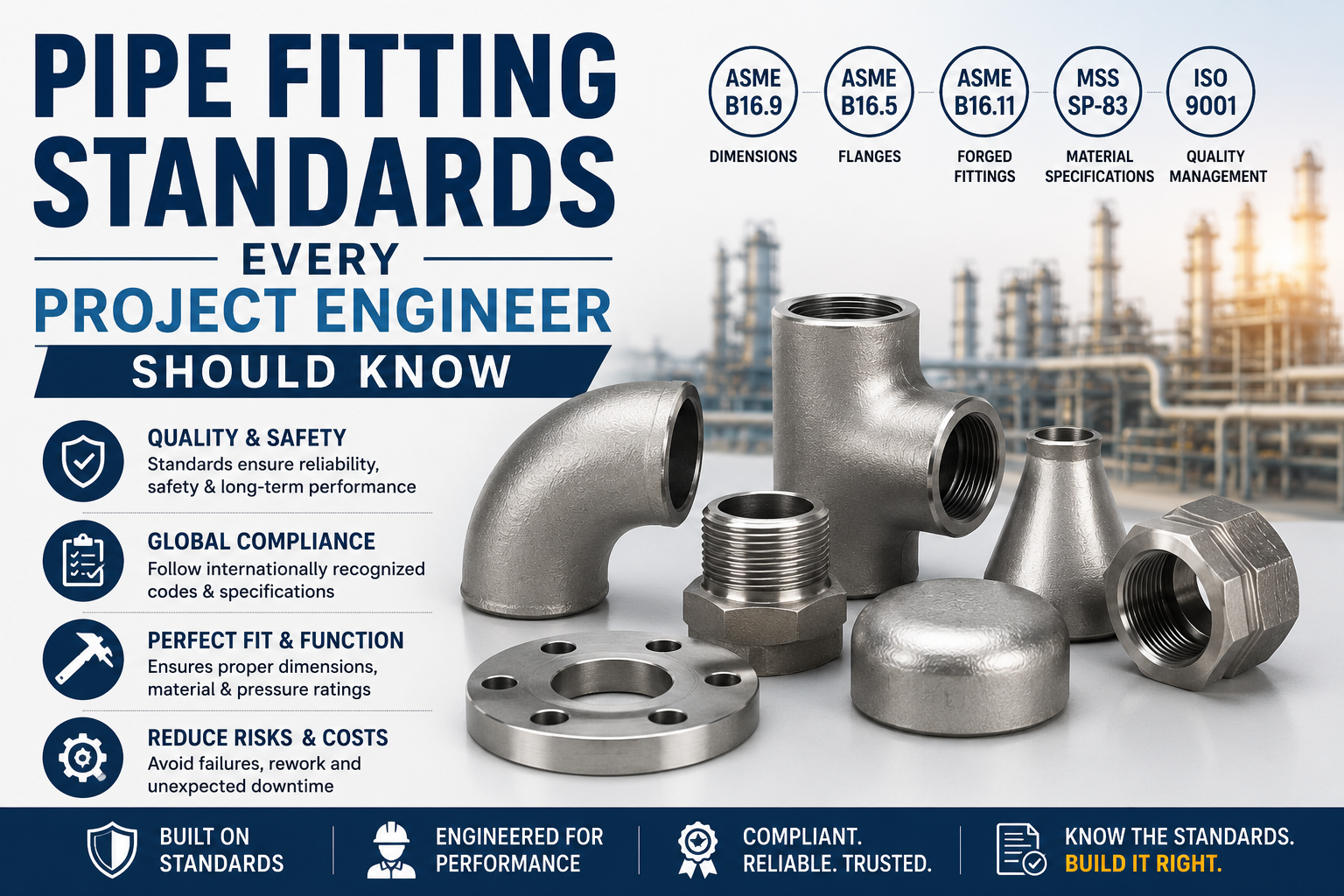
ASME (American Society of Mechanical Engineers) publishes the dimensional and design codes most engineers reach for first. ASME B16.9 covers factory-made butt-welding fittings such as elbows, tees, and reducers. ASME B16.11 covers forged socket-weld and threaded fittings. ASME B31.3 (Process Piping) governs how these fittings are applied within a piping system, including wall thickness, pressure design, and fabrication tolerances. Any specification packet referencing “code compliance” on a UAE oil & gas project is almost always pointing back to one of these ASME documents.
ANSI Pipe Fitting Dimensions
ANSI (American National Standards Institute) doesn’t write piping codes directly anymore, but it accredits the standards bodies that do, and older drawings still label dimensional tables as “ANSI B16.9” or “ANSI B16.5.” When you see ANSI pipe fitting dimensions referenced on a legacy drawing, treat it as functionally equivalent to the current ASME edition — the dimensional tables for elbows, tees, and flanged fittings haven’t changed in substance, only in the issuing body’s name.
ASTM Pipe Fitting Standards
While ASME defines shape and dimension, ASTM pipe fitting standards define what the fitting is made of and how it’s tested. ASTM A234 covers carbon and alloy steel fittings for moderate and high-temperature service. ASTM A420 covers fittings for low-temperature applications. ASTM A105 governs forged carbon steel flanges and fittings, and ASTM A182 covers forged alloy and stainless grades. A fitting stamped “A234 WPB” tells a QA/QC inspector both the material family and the intended service condition in a single marking.
Pipe Fitting Material Standards and Common Grades
Material selection is where pipe fitting material standards intersect directly with process conditions — pressure, temperature, and the fluid being carried. Common grades encountered on UAE process and marine projects include:
- WPB and WPHY grades (carbon steel, per ASTM A234) for standard hydrocarbon and utility service
- LF2 and F42/F52/F60/F65 (forged low-temperature and high-yield grades) for critical service lines
- WPL6 (low-temperature carbon steel) for cryogenic or cold-climate piping
- Duplex, super duplex, and Inconel 625/825 grades for sour service and offshore applications where corrosion resistance is non-negotiable
Getting the grade right isn’t cosmetic. A fitting rated for standard service installed on a sour-gas line can fail well before its design life, which is why procurement teams should always cross-check the material test certificate against the line’s process datasheet before releasing stock for installation.
Pipe Fitting Classes and Ratings
Pressure-temperature ratings determine how much a fitting can safely handle before failure risk rises. Fittings are typically specified by schedule (wall thickness, such as Schedule 40, 80, or XS) for butt-weld types, and by class (2000#, 3000#, 6000#, 9000#) for socket-weld and threaded types. A 6000# forged fitting, for example, is built for substantially higher pressure service than a 3000# equivalent of the same nominal size. Specifying by class alone, without confirming schedule and material grade together, is one of the most common errors on fast-tracked EPC packages — and one of the easiest to catch during a document review.
Welded vs Threaded Pipe Fittings
Choosing between welded vs threaded pipe fittings comes down to service severity, pipe size, and maintenance access.
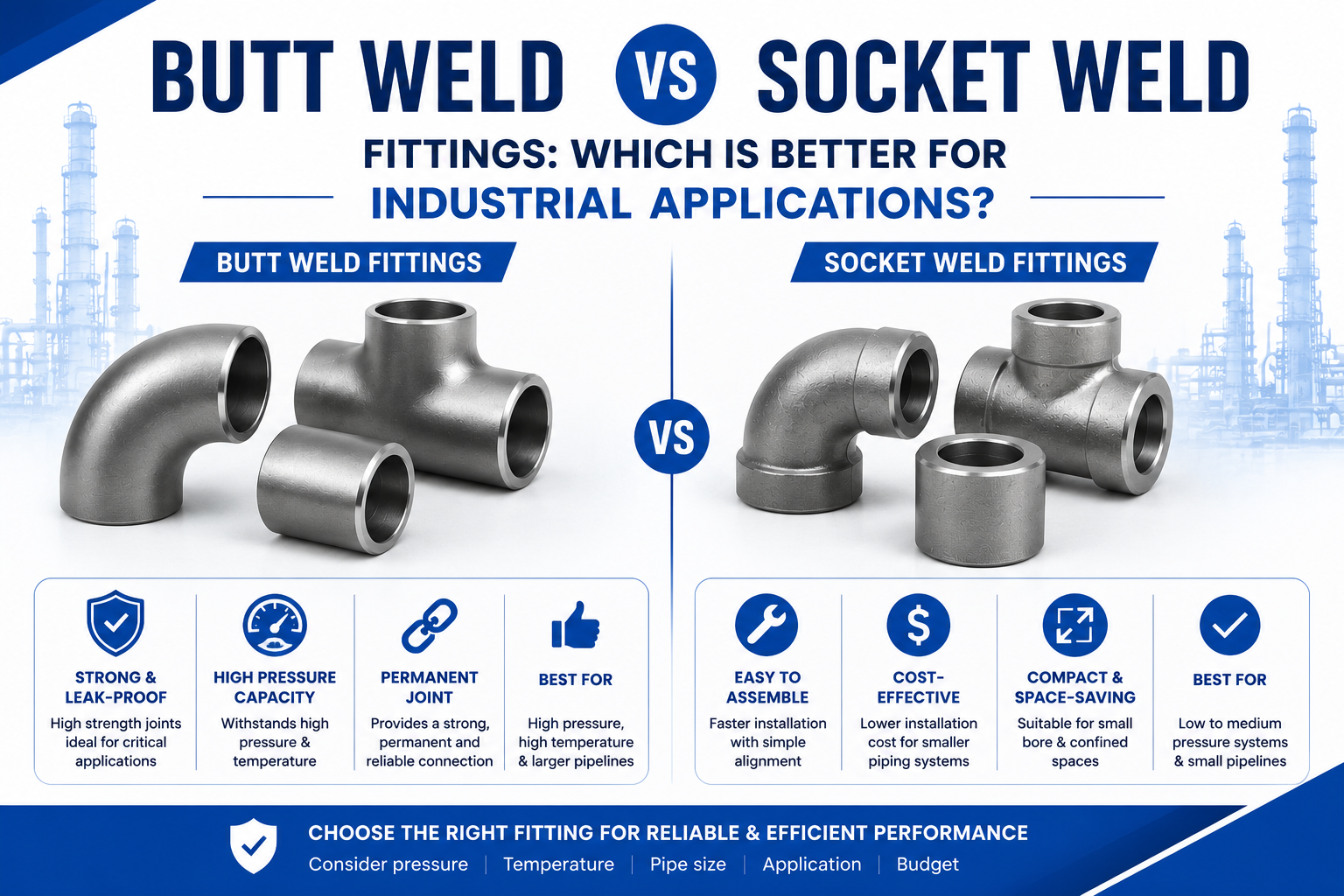
Butt-weld and socket-weld fittings, governed by ASME B16.9 and B16.11 respectively, produce a permanent, leak-tight joint suited to high-pressure hydrocarbon, steam, and critical process lines. Butt-weld is generally preferred above 2 inches nominal bore; socket-weld suits smaller bore, high-pressure lines where full penetration welding is impractical.
Threaded fittings, typically per ASME B16.11 or MSS SP-83, are faster to install and easier to disassemble for maintenance, making them common in utility, instrument air, and low-pressure plumbing services. They are rarely specified for hydrocarbon service above moderate pressure, since thread engagement is inherently more susceptible to leakage under cyclic loading.
Pipe Fitting Specifications for Engineers — A Practical Selection Guide
When developing pipe fitting specifications for engineers on a new project, a consistent review sequence prevents costly rework later:
- Confirm the governing piping design standards code (usually ASME B31.3 for process plants) from the project basis of design
- Match fitting dimensions to ASME B16.9 (butt-weld) or B16.11 (socket-weld/threaded)
- Select the material grade against ASTM standards based on service temperature and corrosion allowance
- Verify pressure class or schedule against the line’s design pressure, not just the nominal pipe size
- Cross-check any additional industrial pipe fitting codes required by the client or third-party inspection agency
- Request material test certificates and, where required, third-party inspection reports before releasing fittings to site
Suppliers holding a wide certified inventory — like Leema Engineering’s pipe fittings range, stocked across ASTM A234, A420, A105N, A350, and A694 grades — can significantly shorten this verification cycle, since certificates and grade data are available before the requisition is even issued.
Industrial Pipe Fitting Codes and Compliance Across the UAE
For EPC contractors and procurement teams operating across the UAE, compliance isn’t limited to ASME and ASTM. Projects for national oil companies and major EPCs frequently layer in additional industrial pipe fitting codes, MSS standards (such as MSS SP-75 for high-strength butt-weld fittings), DIN, and API references depending on the client’s engineering standard. Working with a supplier that maintains stock across pipes, pipe fittings, and flanges under one roof, sourced to these overlapping codes, reduces the coordination burden on procurement significantly, particularly on fast-tracked oil and gas piping projects.
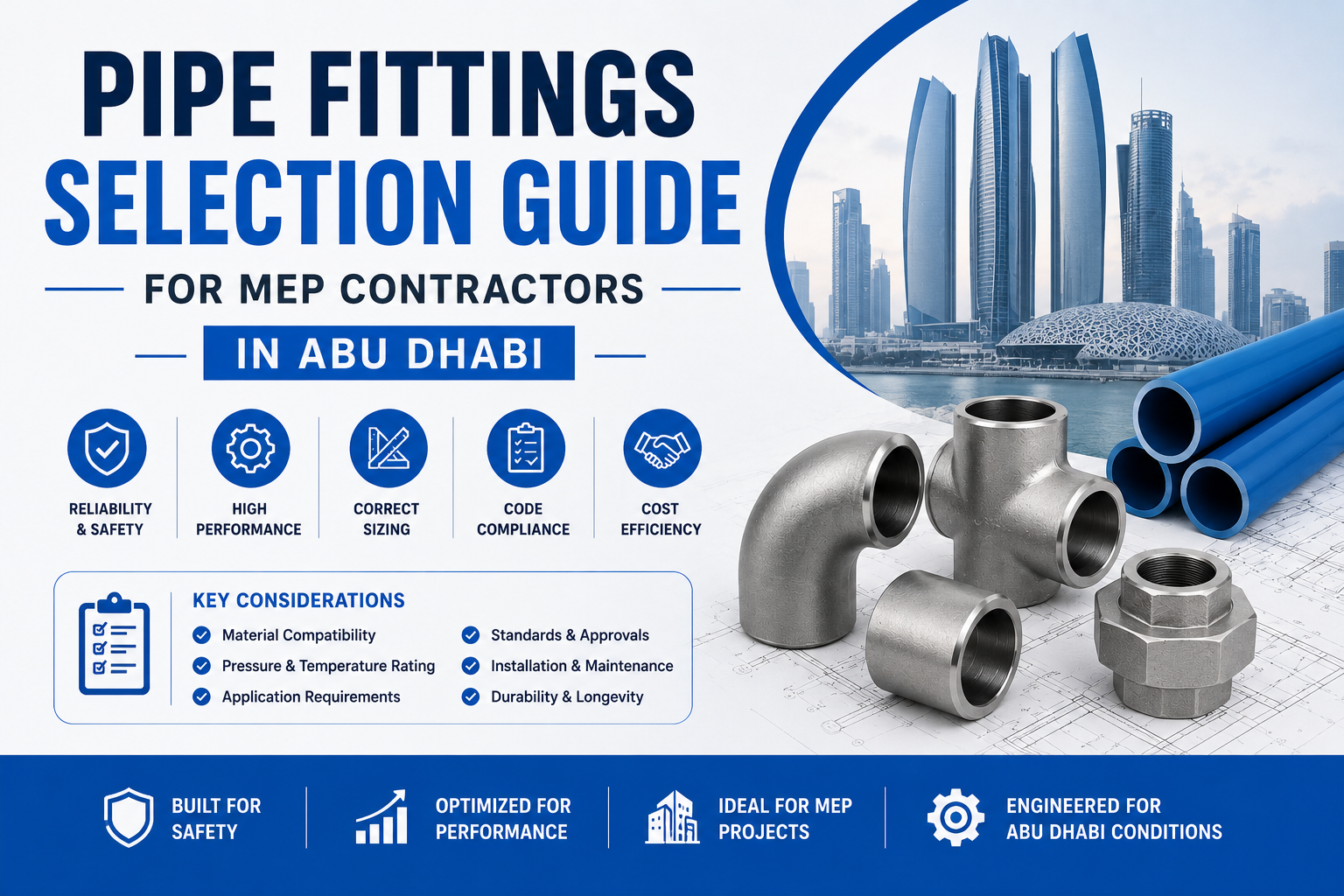
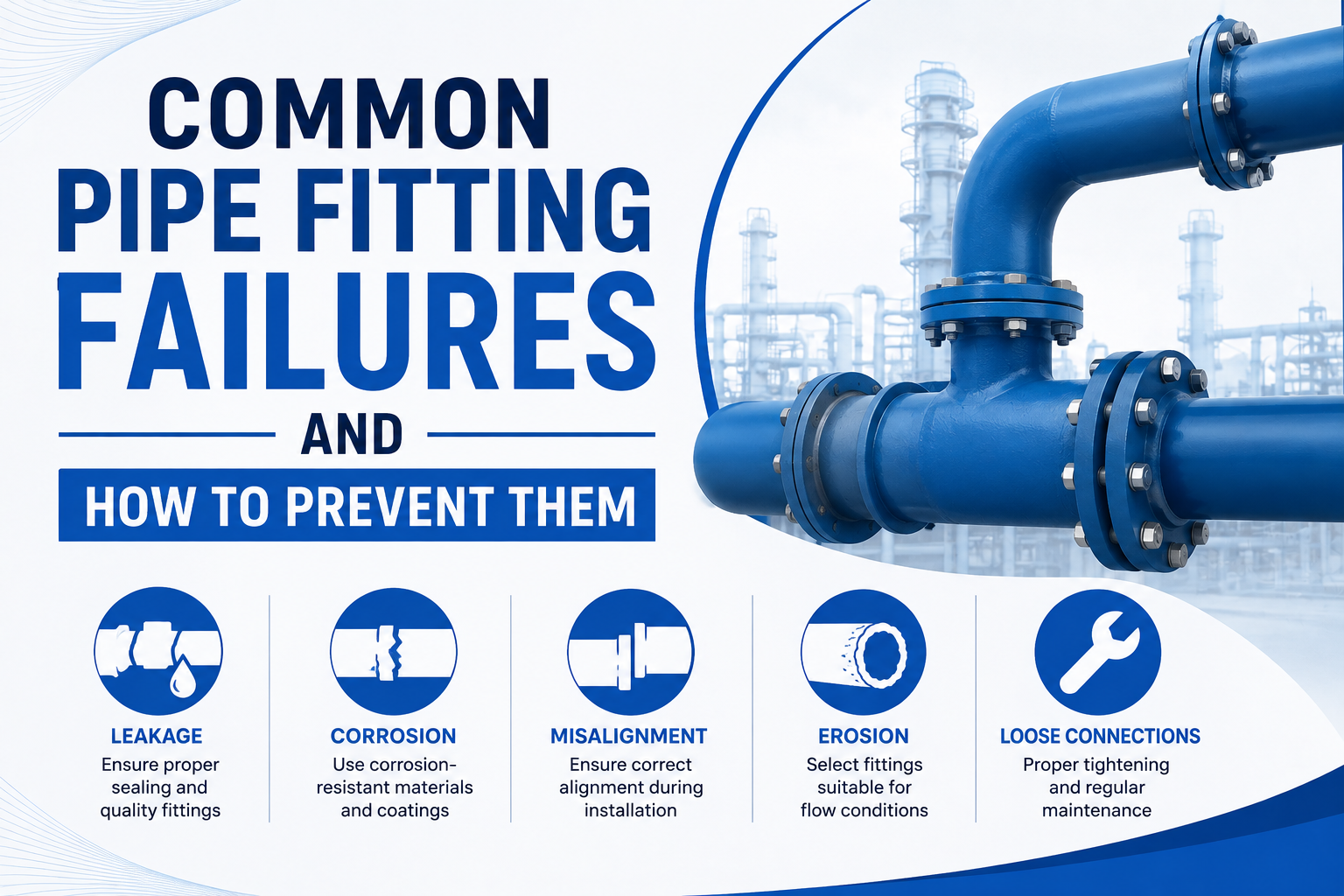
If your project has recently run into fitting-related rework, it’s worth reviewing common pipe fitting failures and how to prevent them, and for MEP-specific packages, the pipe fittings selection guide for MEP contractors in Abu Dhabi covers selection criteria in more depth. For a closer comparison of connection types, see butt weld vs socket weld fittings for industrial applications.
Frequently Asked Questions
What are the main pipe fitting standards engineers should know? The core set is ASME B16.9 and B16.11 for dimensions, ASME B31.3 for process piping design, and ASTM A234, A420, A105, and A182 for material grades.
What is the difference between ASME and ANSI pipe fitting dimensions? ANSI accredits the standards development process, while ASME publishes the current dimensional codes. Legacy “ANSI B16.9” references are functionally the same as today’s ASME B16.9.
How do I choose between welded and threaded pipe fittings? Use welded fittings for high-pressure and critical hydrocarbon service, and threaded fittings for low-pressure utility or instrument lines where ease of maintenance matters more than joint strength.
What do pipe fitting classes like 3000# or 6000# mean? These ratings indicate the pressure-temperature capability of the fitting; higher numbers indicate a fitting built for more demanding service conditions.
Why do material certificates matter for pipe fittings? They confirm the fitting meets the specified ASTM grade and heat treatment condition, which is required documentation for QA/QC sign-off on most EPC and oil & gas contracts.
Sourcing certified pipe fittings for your next project? Leema Engineering Works stocks ASME- and ASTM-compliant pipe fittings, pipes, and flanges with full material certification, serving EPC, QA/QC, and procurement teams across Abu Dhabi and the wider UAE.
📍 Baniyas Najda Street, Al Danah, Zone 1, Abu Dhabi, United Arab Emirates 📞 +971 6 533 8167 | +971 50 425 1818 ✉️ sales@leemaeng.com